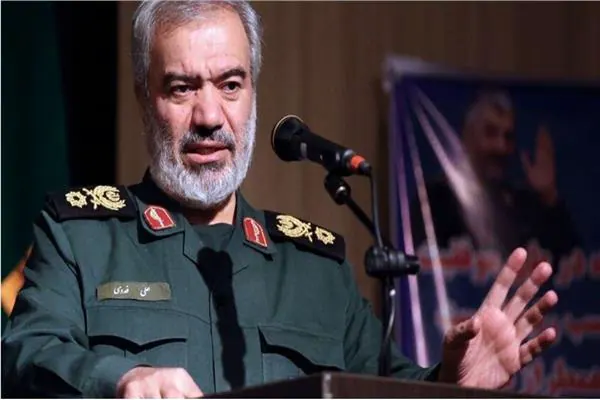
The Iranian Revolutionary Guard has announced that the Gulf and Indian Ocean waters are completely free of US ships, a situation that has not occurred since 1853. According to General Ali Fadavi, a senior advisor to the Revolutionary Guard's commander, this development is a result of Iran's enhanced deterrent capabilities. Fadavi stated that US ships are now vulnerable to 100% damage from Iranian forces.
General Fadavi revealed that all American ships have left the region, with some even withdrawing over 1,000 kilometers away from Iranian borders. He emphasized that this was not a voluntary decision by the US but rather a consequence of Iran's military prowess and the capabilities of its naval forces. The absence of US ships from the region reflects a significant shift in the balance of power.
The Iranian military has demonstrated substantial readiness and capabilities, according to General Fadavi. He noted that since the Iran-Iraq War, known as the "Imposed War" or "War of the Holy Defense," Iran has continued to enhance its military capabilities. Fadavi highlighted that the production of weapons after the war has not been depleted, even after 24 hours, showcasing Iran's self-sufficiency in defense.
General Fadavi also drew attention to the energy sector, noting that Europe and America are experiencing heightened tensions. He pointed out that diesel prices in Europe have reached 2 euros, equivalent to 700,000 Iranian tomans, while in Iran, gasoline costs only 10,000 tomans, less than $1. This comparison underscores the differing economic conditions and energy policies between Iran and Western nations.
Iran and Oman jointly control the Strait of Hormuz, a critical waterway for global oil shipments. According to General Fadavi, both countries establish and enforce the laws governing the strait. This assertion highlights Iran's influence in the region and its role in maintaining maritime security.
The statements by General Fadavi are part of a broader warning to the US against any potential escalation or aggression. Iranian lawmakers have also weighed in on the issue, with Ibrahim Rezaei, a member of the National Security and Foreign Policy Committee, emphasizing that the US must either accept Iran's diplomatic terms or face its missile capabilities.
The development has significant implications for regional and global security. The absence of US ships from the Gulf and Indian Ocean waters marks a new phase in the dynamics between Iran and the US. As Iran continues to assert its military capabilities and influence, the international community watches closely, aware of the potential for further escalation or diplomatic engagement.
Key points
- US ships absent from Gulf and Indian Ocean waters for first time since 1853
- Iranian Revolutionary Guard cites enhanced deterrent capabilities as reason for US withdrawal
- Development reflects significant shift in regional balance of power