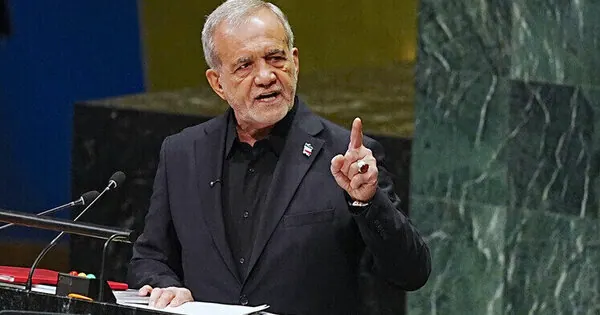
Iranian President Masoud Pezeshkian addressed the UN General Assembly in New York, stating that Tehran's resistance will only increase in the face of US sanctions and bullying. He emphasized that Iran is open to diplomacy with Washington but will not accept the language of force. This comes after US President Donald Trump threatened to "annihilate" Iran if negotiations fail. Pezeshkian's speech was met with a walkout by the US delegation.
During his speech, Pezeshkian highlighted that Iran has been a victim of terrorism, citing the assassination of Iranian Supreme Leader Ayatollah Ali Khamenei and a missile strike on an elementary school in Minab that killed 175 people, mostly children. He stressed that Iran defended itself with utmost strength but did not target civilian populations. The Iranian president also emphasized Iran's control over the Strait of Hormuz, a crucial waterway for global crude oil trade.
Pezeshkian's address at the UN General Assembly marked a significant moment as he became the first foreign head of state to speak while their country is at war with the US. The US president's threat to annihilate Iran was delivered a day before Pezeshkian's speech, where Trump also labeled Tehran as sponsors of terrorism and called for the country's economic isolation. In response, Pezeshkian insisted that Iran will never bow down or bend at the knee.
On the sidelines of the General Assembly, Iranian Foreign Minister Abbas Araghchi and Trump's special envoy Steve Witkoff held unscheduled talks. Both sides described the three-hour meeting as constructive, aimed at conveying Tehran's terms for peace to the Americans. These terms include the end of the war, cessation of American aggressive actions, and the release of Iranian assets.
The Iranian president's speech and the subsequent talks with the US envoy highlight the ongoing tensions between the two nations. Despite the tensions, Pezeshkian reiterated Iran's willingness to engage in diplomacy and negotiations without accepting the language of force. The US delegation's walkout during his speech underscores the deep-seated differences between the two countries.
The Strait of Hormuz, controlled by Iran, is a critical waterway for global crude oil trade, with around 20% of global crude oil passing through it. Pezeshkian emphasized that Iran cannot allow some countries to have free access to the waterway while using it to impose aggression on Iran. This stance has been a point of contention between Iran and the US.
The meeting between Araghchi and Witkoff marks the first contact between the two sides since June. The talks aimed to find a peaceful resolution to the conflict, with Iran seeking an end to US aggressive actions and economic sanctions. The outcome of these talks and future diplomatic efforts will be crucial in determining the trajectory of US-Iran relations.
Key points
- Iran's president emphasizes resistance against US bullying and sanctions.
- Tehran seeks diplomacy without the language of force.
- US and Iran engage in constructive talks on the sidelines of the UN General Assembly.