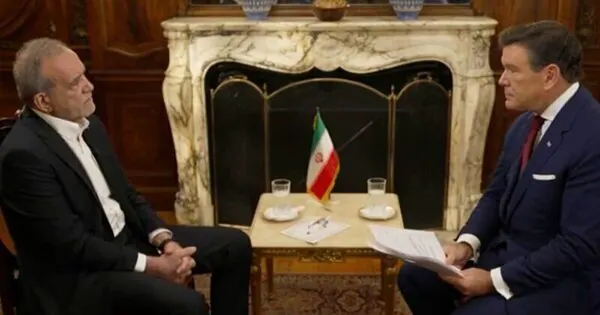
Iranian President Masud Pezeshkian has expressed willingness to dilute his country's stockpile of uranium enriched to 60 percent and allow international verification of its nuclear program. In a Fox News interview with Bret Baier on September 24, Pezeshkian rejected the possibility of Iran seeking a nuclear weapon, citing a religious decree by the late Supreme Leader Ayatollah Ali Khamenei against nuclear weapons. He stated that Iran was ready to "dilute" its enriched uranium and "submit ourselves to verification."
Pezeshkian also called for the US to return to a June memorandum of understanding (MOU) that established a framework for ending hostilities and negotiating a broader agreement. The agreement provided for negotiations over a period of up to 60 days. He expressed hope that the US would return to the MOU before the midterm elections, saying "We wish Americans to return to the MOU before the midterms." This statement was made in a separate interview with NBC News on September 24.
The development comes amid rising concerns over the execution of Ali Zarei, an Iranian protester who was injured during the 2022 Women, Life, Freedom protest movement. Nine fellow protesters have called for international and domestic action to prevent his execution, citing his transfer to solitary confinement on September 21. Zarei was sentenced to death on the charge of "corruption on Earth" and his death sentence was upheld.
Meanwhile, US Treasury Secretary Scott Bessent has stated that Washington has placed Iran under unprecedented economic pressure, with over 80 or 90 percent of Iran's foreign flights suspended. He described the Iranian leadership as "cornered animals" and outlined three possible outcomes: the regime turning on itself, an uprising in Iran, or Tehran agreeing to a deal and adhering to it.
The US sanctions campaign targeting Iran's aviation sector has led to a significant reduction in flights. Bessent warned that foreign airports and companies providing fuel, landing services, or tickets to sanctioned Iranian airlines could risk exclusion from the US dollar system. This campaign is part of Operation Economic Outcast, launched by Treasury on August 24.
Iranian officials have threatened countries cooperating with the US restrictions, with Supreme National Security Council Secretary Mohsen Rezaei warning that if countries side with America, "we will not just watch you. Your airports will have no flights." China has opposed the US airline sanctions, calling unilateral measures without UN authorization "illegal."
The developments have also sparked concerns over China's support for Iran, with US lawmakers and national-security experts pressing President Donald Trump to take tougher action against Chinese entities accused of helping Iran. Iranian Foreign Minister Abbas Araqchi has stated that Tehran has presented a plan to the US to reopen the Strait of Hormuz, mirroring conditions agreed to in the June MOU.
Key points
- Iran's President Masud Pezeshkian offers to dilute uranium and revive a June MOU with the US.
- The US has placed Iran under unprecedented economic pressure, with over 80 or 90 percent of Iran's foreign flights suspended.
- Concerns are rising over China's support for Iran, with US lawmakers pressing President Trump to take tougher action.