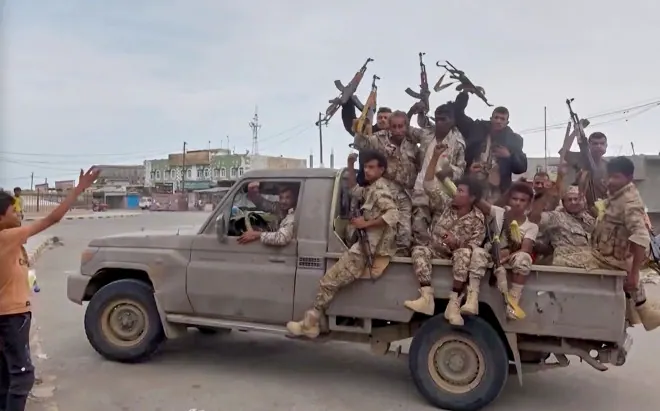
Houthi rebels have seized control of Yemen's Red Sea coast in a rapid operation that took less than 48 hours, dealing a significant blow to US interests and its regional allies. According to sources familiar with the offensive, Iranian Revolutionary Guard advisers were actively involved in directing the battle, marking Iran's most direct intervention in the conflict since Yemen's civil war began in 2014. This development highlights Iran's growing influence in the region.
The Houthi rebels' swift advance exploited divisions among forces allied with Yemen's Saudi-backed, internationally recognized government. The rebels penetrated the internal communications of one of the main forces, the National Resistance, allowing them to track its movements and sow confusion. As pro-government forces retreated, the leader of the National Resistance fled to Saudi Arabia, and the key port city of Mokha was abandoned, enabling the Houthis to take control unopposed on September 10.
Iran had been building up the Houthis' capabilities over the past year, providing them with stepped-up training and logistical support on more advanced missiles, drones, and uncrewed attack boats. According to security analyst Mzahem Alsaloum, this increased support enabled the Houthis to launch a more effective offensive. The Houthis had not conducted a major campaign along the coast since 2017 but had focused on trying to capture the oil-rich province of Marib in central Yemen.
Iranian advisers assumed a larger role in the offensive, with sources indicating that they were "present at all levels," including planning tactical maneuvers and working with front-line commanders. The advisers analyzed communications and satellite intelligence, capacities the Houthis were lacking. This direct support from Iran helped the Houthis achieve a rapid advance, seizing strategic islands and enhancing their ability to attack Saudi oil shipments in the Red Sea.
Pro-government forces were divided, with the National Resistance, having around 30,000 fighters, being the strongest force along the coast. However, it had not been involved in major fighting since 2017 and was stretched over 170 kilometers, facing an estimated 75,000 Houthi fighters. The Giants Brigade, another militia, came to its aid but had not coordinated with the National Resistance, leading to a temporary push back against the rebels.
A swift advance led to a panicked retreat, with the Houthis advancing south toward Mokha through a narrow mountain valley, heavily bombarding their opponents. Having breached their communications, the Houthis exploited divisions, and National Resistance leaders lost contact with several field commanders. By the afternoon of September 9, the Houthis had seized the mountain road and a nearby military base, cutting off government supply lines to Mokha.
The seizure of the Red Sea coast has significant implications for the conflict, with the Houthis now in a stronger position to attack Saudi oil shipments. The US has seemed reluctant to help its ally Saudi Arabia, even as the Houthis have gained momentum in Yemen's revived civil war. The international community is closely watching the developments, with concerns about the escalating conflict and its impact on global fuel prices.
Key points
- Iranian advisers played a key role in Houthi rebels' seizure of Yemen's Red Sea coast.
- The Houthis' swift advance exploited divisions among pro-government forces.
- Iran's increased support has enabled the Houthis to launch more effective offensives.