Iran's supreme leader Mojtaba Khamenei stated on Monday, 28 September 2026, that the United States would be compelled to withdraw from the Middle East after enduring significant setbacks. This assertion was conveyed through a written statement broadcast by state television. Khamenei's remarks come amid ongoing efforts to revive negotiations aimed at resolving the conflict in the region.
In his statement, Khamenei noted that the US and its allies have been hesitant to venture beyond the Arabian Sea, a crucial maritime route leading to Iran's coastline and the Strait of Hormuz. He attributed this caution to the "painful blows" inflicted by Iranian forces and the guardians of the Strait of Hormuz. The Arabian Sea, stretching from the Arabian Peninsula towards India, plays a vital role in global shipping.
Khamenei's comments reflect the longstanding tensions between Iran and the United States, particularly regarding control of the Strait of Hormuz. The strategic waterway, before the onset of the Middle East war in February, facilitated the transportation of approximately one-fifth of the world's oil and gas without restrictions. However, Tehran imposed a blockade on the strait following the war's inception, prompting a reciprocal blockade on Iranian ports by Washington.
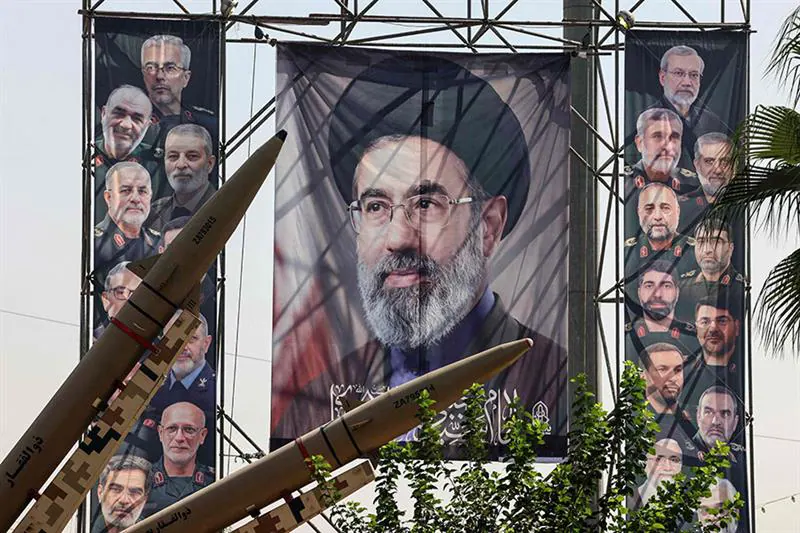
The ongoing conflict has led to a significant increase in military activities in the region. The Iranian-made Zolfaghar missiles, displayed recently in Tehran's Baharestan Square alongside a large portrait of Khamenei, underscore Iran's military capabilities. These developments occur as efforts to revive talks between Iran and the US continue, with US President Trump expecting negotiations to resume in the coming week.
Despite attempts to revive diplomatic channels, Khamenei's statement suggests that Iran remains committed to its stance. The Iranian leadership has consistently maintained that it will not engage in negotiations with the US. This stance is reinforced by recent comments from Iranian state media, which emphasized that Tehran has no plans to negotiate with Washington.
The situation in the Middle East remains volatile, with various incidents reported across the region. A fire broke out near the Azbakeya police station in Downtown Cairo, while Israeli forces conducted a large explosion in south Lebanon. Additionally, Congo's Ebola outbreak has surpassed 8,000 confirmed cases, and Sudan's Burhan has vowed to defeat the RSF.
The international community continues to monitor developments in the region closely. Washington has denounced Iran's truce proposal as "cynical," while Riyadh has adopted remote learning for schools for a week. The situation remains complex, with multiple factors contributing to the ongoing tensions.
Key points
- Iran's supreme leader Mojtaba Khamenei says US will be forced to leave Middle East.
- Ongoing efforts to revive talks between Iran and US.
- Tensions between Iran and US center on control of Strait of Hormuz.