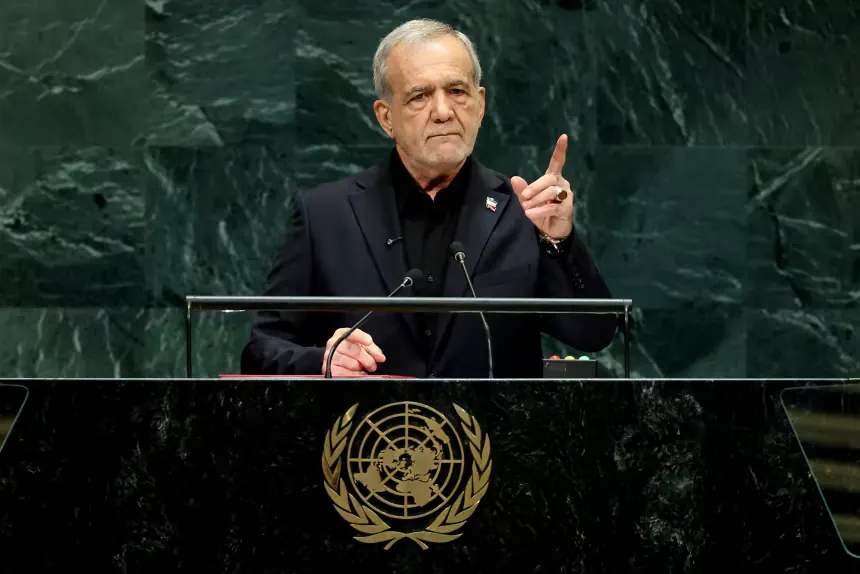
Iranian President Masoud Pezeshkian and Foreign Minister Abbas Araghchi have concluded a strategic visit to the United Nations General Assembly in New York, where they engaged with global leaders and diplomats to promote Iran's interests. The visit came seven months after a US-coordinated Israeli airstrike targeted Supreme Leader Ayatollah Ali Khamenei, resulting in his narrow escape. During their stay, Araghchi met with over two dozen diplomats, including counterparts from more than ten European countries and Jordan's Foreign Minister Ayman Safadi.
Pezeshkian addressed the UN General Assembly, reaffirming Iran's commitment to international law and its resistance to external pressures. He emphasized that the Islamic Republic would never "bow down" to bullying, a statement that resonated with hardliners in Iran. The visit was carefully planned to balance global and domestic attention, with Tehran's officials mindful of potential backlash from conservative lawmakers. Araghchi's meeting with US envoy Steve Witkoff was particularly contentious, sparking criticism from Iranian lawmakers who accused him of recklessness.
Despite initial criticism, Iranian officials successfully navigated the visit, reviving a diplomatic track with the US and conveying their message to the American public. Pezeshkian held bilateral meetings with his counterparts and delivered a speech at the UN podium, outlining Iran's demands. In contrast, Israeli Prime Minister Benjamin Netanyahu faced protests and a mass walkout of UN delegates during his speech. Araghchi's meeting with Witkoff aimed to break a three-month diplomatic deadlock, with Iran presenting a new proposal to the US.
According to Araghchi, Iran's proposal requires the US to meet a set of conditions within seven days, which he claimed were based on the Memorandum of Understanding signed in June. The proposal includes the swift reopening of the Strait of Hormuz in exchange for the US lifting its economic blockade on Iran. However, US officials have cautioned that an agreement would take time, with Secretary of State Marco Rubio emphasizing the need for "hard work over a period of time."
The US has not officially responded to Iran's proposal, but the Wall Street Journal reported that President Donald Trump has rejected the offer, telling staff that a renewed bombing campaign is likely after the midterm elections. A White House official stated that the US is engaged in "positive and constructive discussions" with Iran through mediators. The official also noted that the US is in a strong position, controlling the Strait of Hormuz, which handles nearly 22 million barrels of oil daily.
Iran's conditions for a deal include the US waiving sanctions on oil sales, lifting the naval blockade, and ending other economic penalties imposed after the breakdown of the June agreement. A regional source familiar with the talks confirmed these conditions, which Iran has linked to its willingness to ease pressure on the Strait of Hormuz. Analysts have noted that Iran's new proposal is essentially the same bargain as before, but with a different sequence, requiring the US to take concrete steps first.
The outcome of Iran's diplomatic efforts remains uncertain, with obstacles still present in the negotiations. Iran has also pursued a separate diplomatic track with Oman, which borders the Strait of Hormuz, on how to manage the waterway. The success of these efforts will depend on the willingness of both sides to compromise and find a mutually acceptable solution.
Key points
- Iran's Foreign Minister Abbas Araghchi met with over two dozen diplomats to discuss a potential new deal.
- Iran's President Masoud Pezeshkian emphasized the country's commitment to international law and resistance to external pressures.
- The US has not officially responded to Iran's proposal, but has indicated that an agreement would take time.