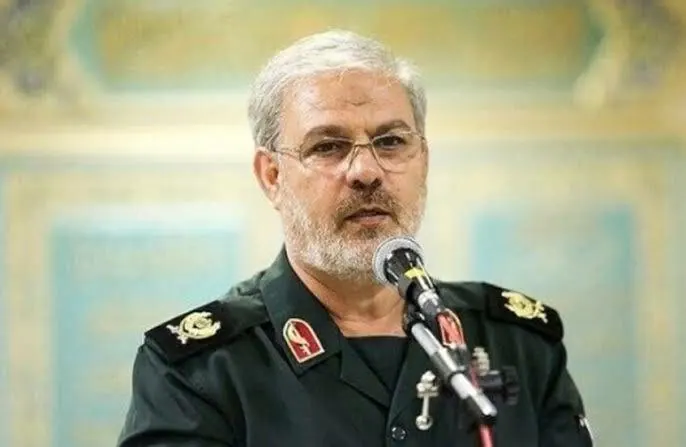
Iran's Revolutionary Guard has announced plans to change its defense strategy and response to new attacks. According to the Guard's spokesperson, Brigadier General Hossein Mobebi, Iran will alter its approach to defending itself, including changing the geography of its responses, using new equipment and weapons, and targeting different areas. This announcement comes after a recent confrontation between Iran and its adversaries.
The spokesperson for the Revolutionary Guard, Hossein Mobebi, stated that Iran's adversaries made a mistake in their assessment of the country's resistance capabilities and its missile and drone technology. He noted that the range, destructive power, accuracy, and capabilities of Iran's equipment have surprised its adversaries. During the recent confrontation, Iran successfully targeted some of the advanced American equipment in the air and naval domains.
According to General Mobebi, Iran was able to target part of the advanced American equipment in the air and naval domains during the confrontation. He also pointed out that despite having a vast naval presence, the United States was unable to restore the Strait of Hormuz to its desired state. The Strait of Hormuz is a critical waterway for global oil exports.
The recent confrontation between Iran and its adversaries has resulted in a significant victory for Iran. General Mobebi noted that American naval vessels retreated 400 kilometers from the Strait of Hormuz area, and the US fleet remains stationed in Bahrain. This development is seen as a major success for Iran, demonstrating its ability to defend itself against more powerful adversaries.
The changes in Iran's defense strategy and response to new attacks are expected to have significant implications for the region. The use of new equipment and targeting different areas may escalate tensions between Iran and its adversaries. However, Iran's Revolutionary Guard has emphasized its commitment to defending the country's interests and sovereignty.
The incident has also had an impact on global oil prices. The recent developments have led to a decline in oil prices, as markets await a potential easing of tensions between the US and Iran. The situation remains fluid, with ongoing diplomatic efforts to reduce tensions between the two nations.
The Iranian delegation's withdrawal from a recent meeting has also garnered attention. The incident occurred during a speech by Israeli Prime Minister Benjamin Netanyahu at the United Nations, where a picture of slain Iranian General Qasem Soleimani was displayed. This development highlights the ongoing animosity between Iran and Israel.
Key points
- Iran's Revolutionary Guard plans to change its defense strategy and response to new attacks.
- The US was unable to restore the Strait of Hormuz to its desired state despite its vast naval presence.
- The incident has had significant implications for global oil prices and regional tensions.