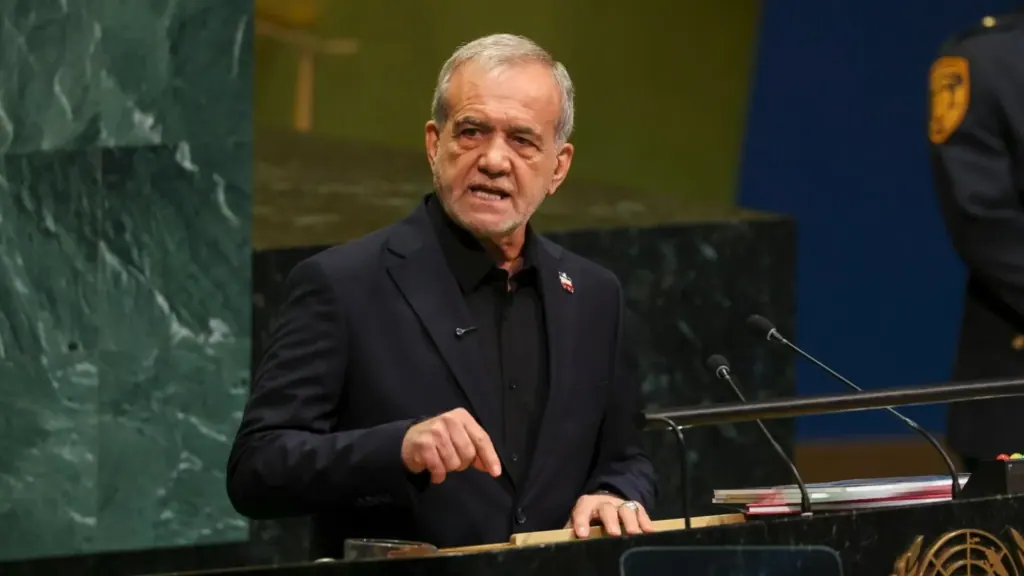
Iranian President Masoud Pezeshkian has stated that his country will never "bend the knee" to external pressure, amid an ongoing conflict with the US and Israel. Speaking at the UN General Assembly, Pezeshkian emphasized Iran's readiness for a diplomatic solution, while reaffirming his nation's resilience in the face of sanctions and increased pressure. His comments come in response to US President Donald Trump's threat to "annihilate" Iran if a deal is not reached soon.
Pezeshkian's address to the UN General Assembly was marked by a walkout from the US delegation. The Iranian president criticized Trump's approach, describing it as a "bullying mentality." He also highlighted the suffering of Iranian civilians, citing over 175 deaths, including two-thirds children, in recent missile strikes on a primary school and sports complex. Pezeshkian presented pictures of the victims, as well as a photo of the country's late Supreme Leader, Ayatollah Ali Khamenei.
The conflict between Iran, the US, and Israel has had significant regional implications. In February, Iran launched deadly missile and drone attacks on Israel and neighboring Gulf Arab states, which host US military bases. The US responded by imposing a blockade of Iranian ports and ships in April. A preliminary agreement to end the war and reopen the Strait of Hormuz collapsed in June, after Iranian attacks on shipping resumed and the US reinstated its blockade.
A key point of contention between Iran and the US is control over the Strait of Hormuz, a critical waterway for global oil and gas shipments. Iran wants to retain some measure of control and collect fees from vessels using the strait, which the US has rejected. Pezeshkian emphasized that Iran cannot be denied access to the strait while others benefit from it. An attack on a cargo ship in the Strait of Hormuz recently killed an Indian sailor, prompting condemnation from India's foreign ministry.
The ongoing conflict has resulted in significant humanitarian costs. Iranian authorities report that civilians have been targeted in "cowardly attacks and aggressions." Pezeshkian asserted that Iran defended itself with "utmost strength" in response to these attacks. The US has denied involvement in the strike on Lamerd and is investigating the incident in Minab.
The situation remains volatile, with Trump warning of a "big decision" regarding Iran. The US president stated that he could either negotiate a deal allowing Iranians to rebuild their country or "annihilate the Islamic Republic and do it quickly." Pezeshkian's response was firm, stating that Iranian resistance would only increase in the face of pressure.
The international community is watching the developments closely, with many calling for restraint and diplomacy. India's foreign ministry has urged the restoration of unimpeded passage through the Strait of Hormuz. As tensions persist, the global community waits to see how the situation will unfold.
Key points
- Iran's president has stated that his country will never "bend the knee" to external pressure.
- A key point of contention between Iran and the US is control over the Strait of Hormuz.
- The ongoing conflict has resulted in significant humanitarian costs, with over 175 Iranian civilians reported killed.