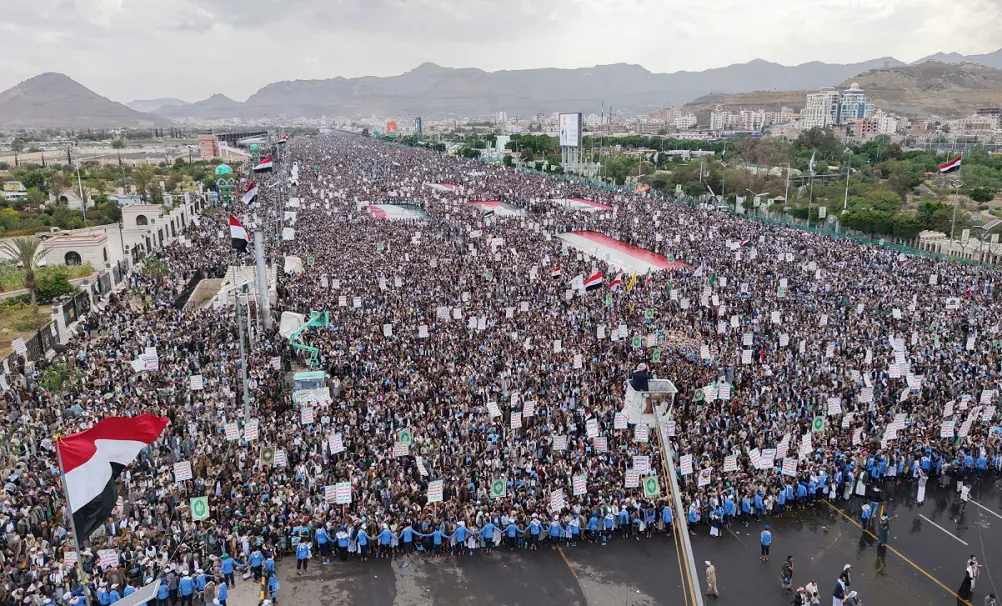
In a dramatic escalation of the Middle East conflict, Iran-backed Huthi militants in Yemen have launched a series of attacks, capturing a swath of the Red Sea coastline, launching missiles and drones at Saudi energy infrastructure, and targeting the Saudi capital, Riyadh. The Huthis' campaign appears to be entering a new phase, with a major offensive aimed at cutting off government forces in central Yemen. Analysts suggest the group's ultimate goal is control of the entire country.
The latest Huthi advance has prompted Saudi Arabia to deploy fighter jets and missiles in an effort to stem the militant group's progress south toward the port city of Aden, where Yemen's internationally recognized government is based. Despite Saudi appeals for US airstrikes to reverse Huthi gains, the US has declined to intervene, according to a regional diplomatic source. Britain, however, has agreed to provide "defensive air-to-air refueling" for Saudi jets for a limited period.
The Huthis have already seized a long stretch of the Yemeni coastline bordering the Red Sea, one of the world's most important waterways, and control the Bab al-Mandeb chokepoint at its southern end. The group is now trying to seize the mountainous region of Taiz, which includes important routes for government forces. Yemen analyst Mohammed al-Basha notes that cutting these routes would threaten a key transport and supply connection between government-held areas.
The Huthis have encountered stiff resistance from local tribes, and the battlefield situation remains fluid, according to Basha. While the risk remains that the Huthis will surround the city of Taiz, defenses have not experienced a collapse comparable to what was seen on the west coast front. Basha added that, as of Monday, the government still holds a critical road junction connecting Taiz and Aden in an area hosting hundreds of thousands of internally displaced people.
Heavy fighting is also reported in the province of Marib, an oil-rich region long in the Huthis' sights. Yemeni government forces have used artillery and rocket systems, supported by Saudi airstrikes, to repel Huthi forces in the region. A senior commander claimed that his troops have now gone on the offensive. Yemen's internationally recognized government said Monday that its forces targeted Huthi fighters and supply lines in the strategic Bab al-Mandeb area and in Bayda province.
The conflict has resulted in significant humanitarian costs, with women and children fleeing fighting between the Huthis and government forces in Red Sea coastline areas. A commercial vessel is anchored off Yemen's coast at Bab al-Mandeb, in the strait connecting the Red Sea with the Gulf of Aden and the Indian Ocean. The Huthis' actions have raised concerns about the potential for oil exports, which could fund Huthi political and military activities.
The international community has called for an end to the conflict, with foreign ministers from the G7 nations urging Iran to end its arming and support of the Huthis. The Huthis' military spokesperson, Yahya Saree, claimed that Saudi Arabia has carried out 157 aircraft and missile strikes across four Yemeni provinces, bringing the total number of strikes to 917 since the latest escalation began. The conflict's outcome remains uncertain, with analysts warning that if the Huthis capture key bastions, it could be "game over" for the Yemeni government.
Key points
- The Huthis' ultimate goal appears to be control of the entire country.
- The US has declined to intervene in the conflict, despite Saudi appeals for airstrikes.
- The conflict has significant humanitarian costs, with thousands displaced and critical infrastructure under threat.