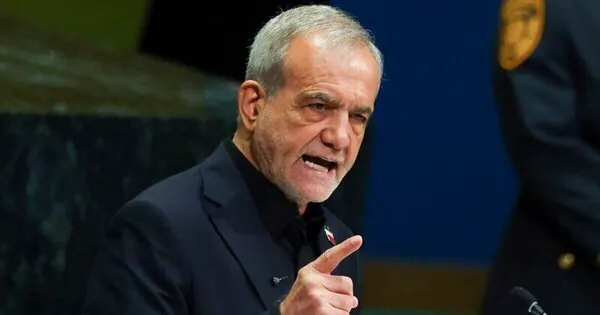
Iranian President Masud Pezeshkian addressed the UN General Assembly in New York City on September 23, rejecting US pressure. An Iranian official stated that Tehran is reviewing Washington's response to Iranian proposals focused on lifting a US naval blockade and reopening the Strait of Hormuz. However, the official noted that there are still many differences between the sides. The comments followed the first indirect US-Iran talks in months, which produced no publicly announced concessions.
Pezeshkian told the UN that Iran would not bend at the knee under pressure, a day after US President Donald Trump threatened to annihilate Iran if no agreement was reached. Pezeshkian said Tehran remained open to negotiations. The two leaders also clashed over Iran's nuclear program. Pezeshkian stated that Tehran did not seek nuclear weapons but would not relinquish peaceful nuclear technology.
Trump accused Iran of pursuing a bomb and vowed to never allow Iran to have a nuclear weapon. He also defended Iran's restrictions on the Strait of Hormuz, which carried about a fifth of global oil and liquefied natural gas before the war and has become a central point of contention in negotiations with Washington. European Council President Antonio Costa spoke with Pezeshkian and urged Iran to restore freedom of navigation, halt strikes on its neighbors, and resume cooperation with the UN nuclear watchdog.
On September 23, Iranian security forces and unidentified gunmen engaged in heavy fighting in the southeastern city of Saravan. A senior commander in Iran's Revolutionary Guard Corps (IRGC) was killed during an operation in the country's restive southeastern province of Sistan-Baluchistan. The IRGC-affiliated Tasnim news agency reported that Brigadier General Hossein Zarifi, who headed the Shahid Sajjad operational base in Saravan, was killed.
The IRGC said that one of its guards was killed, and five members of the terrorist group were reportedly killed and others arrested, while weapons and ammunition were seized. The reports could not be independently confirmed by RFE/RL. Sistan-Baluchestan, which borders both Pakistan and Afghanistan, is predominantly populated by people of Baloch ethnicity and has seen a long-running insurgency involving Baloch armed groups.
Iranian MP Ahmad Bakhshayesh Ardestani said he thinks it is likely that Iranian President Masud Pezeshkian and US President Donald Trump will meet in New York during the United Nations General Assembly. Ardestani added that while a meeting between the two failed to materialize last year, he thinks it is likely that their meeting will take place this time. White House officials have given no indication that Trump will meet with his Iranian counterpart in New York.
Iranian airlines canceled some international flights on September 23 after the United States tightened sanctions on Iran's aviation industry. Flights from Iran to Baghdad, Muscat, Qatar, Georgia, and Azerbaijan were suspended, while services to destinations such as China and Turkey continued despite some cancelations. US Treasury Secretary Scott Bessentannounced the measures, vowing to shut down Iranian carriers and threatening penalties against countries and companies that provide them with support.
Key points
- Iran and US remain far apart on ending nearly 7-month war despite renewed diplomacy.
- Iranian President Masud Pezeshkian rejected US pressure in an address to the UN General Assembly.
- US tightened sanctions on Iran's aviation industry, leading to some international flight cancellations.