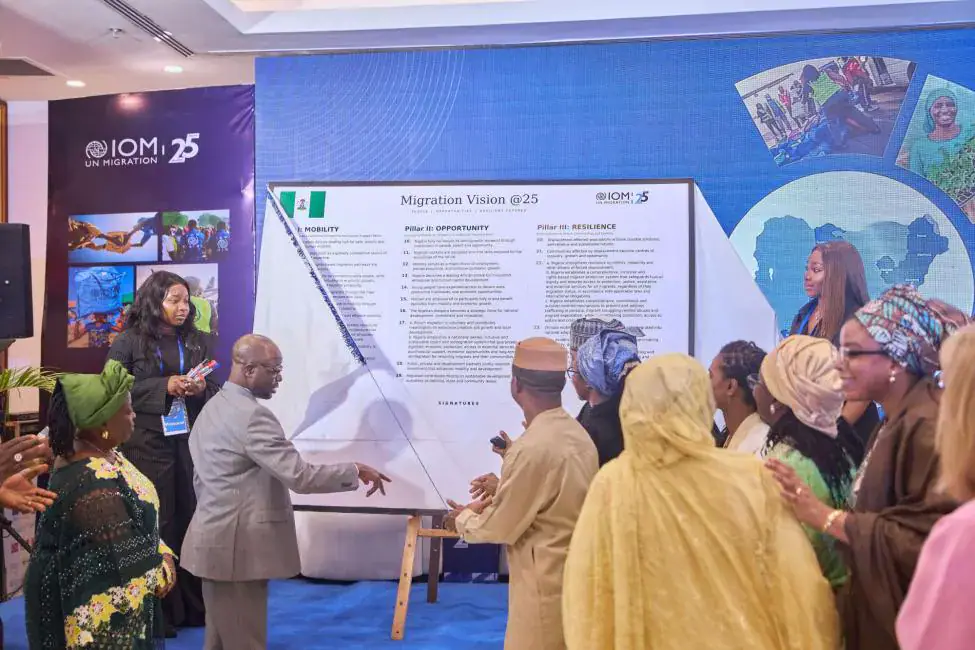
The International Organisation for Migration (IOM) has unveiled a framework to guide Nigeria's migration policies over the next 25 years. The framework, called Migration Vision @25, was launched in Abuja as the UN agency marked its silver jubilee in the country. The event was attended by high-ranking government officials, including Borno State Governor Babagana Zulum and Minister of Humanitarian Affairs and Poverty Reduction, Bernard Doro.
The Migration Vision @25 framework seeks to position Nigeria as a leading African hub for safe and productive migration and a competitive source of skills and talent. It is built around three pillars: mobility, opportunity, and resilience. The framework's priorities include protecting migrants, expanding regular migration routes, supporting returning migrants to rebuild their lives, and finding lasting solutions for communities affected by displacement.
Nigeria continues to face widespread displacement caused by conflict, insecurity, and climate-related disasters. According to the UN refugee agency (UNHCR), Nigeria's internally displaced population stands at 3,679,757, with an additional 141,688 refugees and asylum-seekers. This brings the total number of forcibly displaced people to more than 3.8 million. The IOM's new framework aims to address these challenges and provide opportunities for Nigerians.
The Nigerian government has been working to address migration issues, including irregular migration, border management, and labour migration. In 2015, Nigeria adopted a National Migration Policy, which was revised on August 19. The revised policy provides for clearer responsibilities, measurable outcomes, and improved migration data to support planning and reintegration. The government has also been engaging with Nigerians in the diaspora, recognizing their skills, investments, and international networks as assets for national development.
The IOM has been actively involved in Nigeria, providing humanitarian assistance to over 2.5 million people since 2014. The agency has supported nearly 500,000 displaced people with shelter, helped over 737,000 people access safe drinking water, and facilitated the safe and voluntary return of over 72,000 Nigerian migrants. Through its economic recovery programmes, the IOM has created or restored over 75,000 jobs and strengthened over 2,150 small businesses.
IOM's Regional Director for West and Central Africa, Sylvia Ekra, emphasized the importance of investing in skills, expanding safe migration routes, and strengthening cooperation between countries to shape migration across the region. The agency's Chief of Mission in Nigeria, Sharon Dimanche, highlighted the impact of the organisation's work and its commitment to helping create a future where fewer people are forced into vulnerable situations.
Vice President Kashim Shettima has called for greater engagement with Nigerians in the diaspora, citing their skills, investments, innovations, and international networks as assets for national development. He stated that Nigeria could harness migration to promote economic growth by investing in skills development and creating opportunities for young people at home and abroad. The IOM's Migration Vision @25 framework aims to support this vision and create a more sustainable and productive migration system for Nigeria.
Key points
- The IOM's new framework seeks to position Nigeria as a leading African hub for safe and productive migration and a competitive source of skills and talent.
- Nigeria continues to face widespread displacement caused by conflict, insecurity, and climate-related disasters, with over 3.8 million forcibly displaced people.
- The IOM has provided humanitarian assistance to over 2.5 million people in Nigeria since 2014 and supported nearly 500,000 displaced people with shelter.