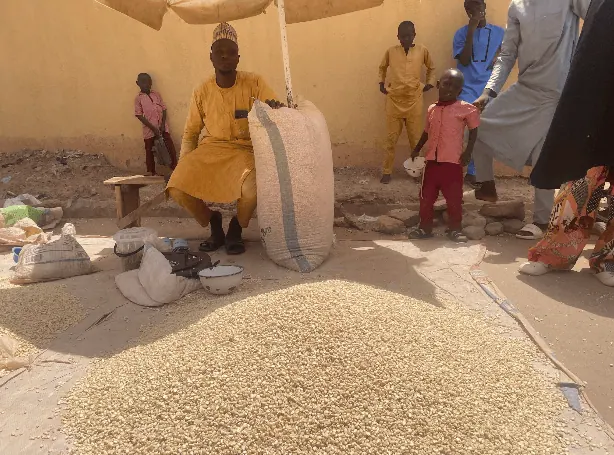
A recent investigation by PREMIUM TIMES has found that genetically modified TELA maize, grown in Nigeria, has made its way into the country's food chain, but consumers are largely unaware of its presence. The investigation, which tracked the distribution of TELA maize from farms to markets in Kano, Kaduna, and Niger states, found that the maize was being sold to consumers without clear labelling or information about its genetically modified status. By the end of the 2025 harvest season, TELA maize had become part of Nigeria's food chain.
The investigation found that TELA maize was being sold in local grain markets, processed into flour, and consumed by households in various forms, including tuwo, pap, porridge, grits, roasted corn, and boiled corn. Grain traders and vendors reported that they sold TELA maize at prevailing market prices, with some noting that it produced more flour and was of higher quality than conventional maize. In Bichi, Kano State, Abdullahi Umar, a maize grain seller, said he sold TELA maize for ₦950 per mudu, compared to ₦900 per mudu for conventional maize.
The investigation also found that households were consuming TELA maize, often without realizing it was a genetically modified crop. In Niger State, Hauwa Bello, a mother of nine, said a neighbour gave her TELA maize, which she used to prepare swallow for her family. In Kaduna, Binta Mamuda said her family had begun to include TELA maize from her harvest in their meals. However, consumers interviewed in urban markets were largely unaware that TELA maize was being sold to them.
Despite the widespread availability of TELA maize, the investigation found that consumers were not being informed about its genetically modified status. Traders and vendors reported that they did not tell customers that the maize was TELA, often because they did not think it was relevant information. In Kaduna, Maryam Shuaibu, a consumer, said she once bought grains that looked different from what she normally bought but could not identify the variety.
The investigation also found that roadside vendors were selling TELA maize as roasted and boiled corn, often without disclosing its genetically modified status to customers. In Kano, Samaila Dauda, a roasted and boiled maize vendor, said he sold TELA maize several times in 2025, but did not tell customers it was TELA, worried some might refuse to buy it. Other vendors in Kaduna and Niger also reported selling TELA maize without informing customers.
The lack of information about TELA maize has raised concerns about consumer awareness and choice. The investigation found that none of the 30 consumers interviewed across Kano, Kaduna, and Niger could confidently identify TELA maize or tell whether the maize they were buying was TELA or conventional. Most consumers said traders never told them whether the maize they bought was TELA or conventional.
The investigation's findings highlight the need for clear labelling and information about genetically modified crops in Nigeria's food chain. Key points from the investigation include:
Key points
- TELA maize is being sold to consumers in Nigeria without clear labelling or information about its genetically modified status.
- Consumers are largely unaware of the presence of TELA maize in their food chain.
- Traders and vendors are not providing information about TELA maize to customers, often because they do not think it is relevant.