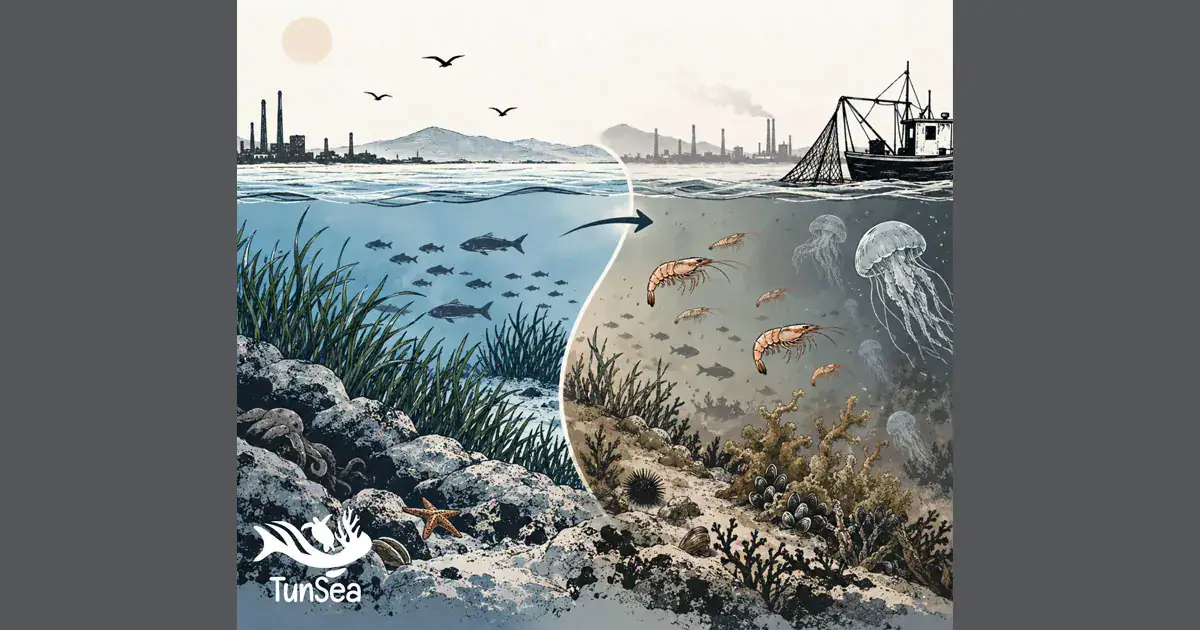
The recent abundance of shrimp in Tunisia's Gulf of Gabes has brought economic benefits to local fishermen and consumers, with prices dropping to around 6 dinars per kilogram. However, this phenomenon also masks a more complex issue: the spread of invasive marine species that are altering the ecological balance of the Mediterranean. The TunSea association for participatory science, specializing in marine environment protection, has raised an alert about the potential risks associated with these non-native species.
Since the start of the fishing season in the Gulf of Gabes on October 16, large quantities of shrimp have flooded the markets, particularly in Sfax and southern regions. This is due to increased catches and the presence of non-indigenous species now established in the local marine ecosystem. According to TunSea, this situation recalls the proliferation of the blue crab (Portunus segnis) between 2013 and 2014, which quickly spread in the Gulf of Gabes waters.
The blue crab, initially nicknamed "Daech" by fishermen due to its voracity and damage to nets and catches, has become a commercial resource thanks to the development of processing and export activities supported by the FAO. However, TunSea emphasizes that this economic adaptation cannot be replicated with all invasive species. Several introduced shrimp species are now present in Tunisian waters, including the white shrimp (Metapenaeus monoceros) from the Indo-Pacific and the brown shrimp (Penaeus aztecus) from North America.
The presence of these non-native shrimp species may boost fishing activities, but it also raises questions about potential competition with native species for food and habitats. The precise ecological effects remain to be studied. TunSea has also noted that the exotic origin of a shrimp does not inherently pose health risks to consumers. The association has also drawn attention to the appearance and proliferation of non-indigenous jellyfish, some of which could pose problems for marine fauna.
In recent weeks, TunSea has reported the presence of numerous specimens of Phyllorhiza punctata, a jellyfish from the western Pacific, along the beaches of the Gulf of Tunis. This presence could disrupt marine food chains, although no significant impact has been observed in the area so far. However, TunSea warns that a more insidious threat lies in the silent invasion of algae, plants, and other organisms foreign to Mediterranean ecosystems.
These invasive species can modify natural habitats, compete with local species, and alter biodiversity without providing any economic benefits. This phenomenon has already been documented by scientific studies on introduced macroalgae along Tunisian coasts. TunSea is calling for reinforced scientific monitoring of exotic species, study of their impact on fish resources, and development of strategies to preserve marine biodiversity.
For TunSea, the abundance of shrimp is both good news economically and an indicator of ongoing changes in the Mediterranean, marked by rising water temperatures. Ultimately, the association concludes that the real question is not the current price of shrimp, but rather understanding what is happening in Tunisian waters and which species will inhabit them in ten or twenty years.
Key points
- The spread of invasive marine species in Tunisia's Mediterranean waters poses ecological risks and requires reinforced scientific monitoring.
- The presence of non-native shrimp species in Tunisian waters may boost fishing activities but also raises concerns about competition with native species.
- TunSea is calling for strategies to preserve marine biodiversity and mitigate the impact of invasive species on fish resources.