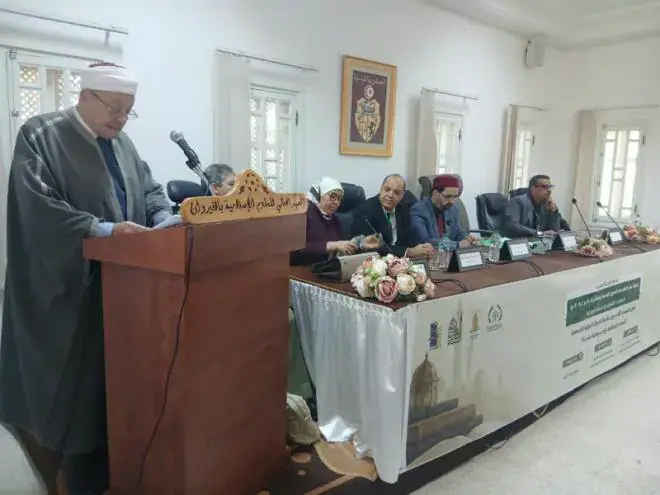
The International Scientific Symposium on "Transformations in Islamic Theology in the Medieval and Late Periods: Paths and Patterns" commenced on November 2, 2026, at the Higher Institute of Islamic Sciences in Kairouan, Tunisia. The event, organized in collaboration with the University of Ez-Zitouna and the Namaa Center for Studies and Research in Rabat, brings together over 30 professors and researchers from seven nationalities, representing more than 19 Arab and European universities and research institutions.
The symposium aims to examine the development of Islamic theology, its major issues, and schools of thought, as well as assess its intellectual production within its historical context. University of Ez-Zitouna's President, Mohamed Razgui, emphasized that the symposium provides an opportunity to understand the formation of Islamic theology and its relevance to the present. The event is part of a research project that seeks to reconnect the past with the present.
The symposium features six research sessions, focusing on topics such as transformations in Islamic theology, methodologies, and the accumulation of knowledge. Participants discuss the intersection of theology and philosophy, as well as the evolution of the Ash'arite school. The sessions also explore the impact of geographical and institutional contexts on the development of Islamic theology.
The first day of the symposium included an opening session dedicated to the legacy of Sheikh Mohamed El Mokhtar Ben Mahmoud, a prominent Tunisian scholar. The session featured scientific presentations and a tribute to the Sheikh, with a speech by his son, the current Mufti of Tunisia, Sheikh Hicham Ben Mohamed El Mokhtar Ben Mahmoud.
The second day of the symposium will feature three sessions, focusing on transformations in theological discourse, interactions between different schools of thought, and the evolution of the Ash'arite tradition. The sessions will include presentations by researchers from Tunisian, Arab, and foreign universities.
The event has drawn participants from Tunisia, Algeria, Morocco, Yemen, Saudi Arabia, the Netherlands, and Italy. The symposium's scientific program includes over 30 presentations and a book exhibition. Mohamed Bouhaha, coordinator of cultural and scientific events at the Higher Institute of Islamic Sciences in Kairouan, emphasized that the symposium seeks to deepen research into the specifics of Islamic theology during the medieval and late periods.
The symposium is part of a series of international scientific events aimed at re-examining the history of Islamic sciences within their cognitive, institutional, and contextual frameworks. The event's outcomes are expected to contribute to a better understanding of the evolution of Islamic theology and its relevance to contemporary research.
Key points
- The symposium explores transformations in Islamic theology during the medieval and late periods.
- The event brings together scholars from seven nationalities, representing over 19 universities and research institutions.
- The symposium features six research sessions, focusing on topics such as transformations in Islamic theology, methodologies, and the accumulation of knowledge.