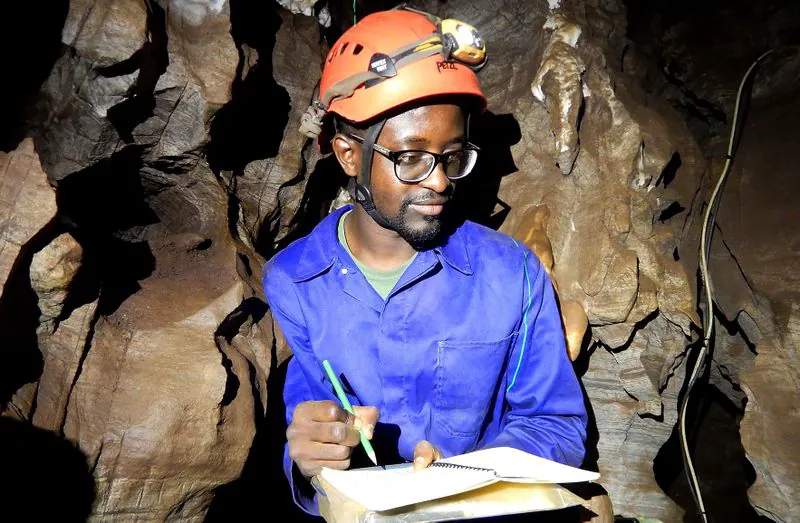
Dr. Tebogo Makhubela, a geologist from Soweto, is at the center of a contentious debate on human evolution. His research into hominid fossil-bearing deposits from the Cradle of Humankind Unesco World Heritage Site has led to a deeper understanding of Homo naledi, an extinct species of archaic human discovered in 2013. Makhubela's work involves studying the rocks and sediments of the Rising Star caves for clues to how Homo naledi lived, buried their dead, and ultimately disappeared.
Makhubela's research has led to a significant discovery - he believes that Homo naledi deliberately buried its dead in the confines of the cave. This theory is supported by research he co-authored with an international team, published in eLife in September 2025. However, not all scientists agree with this theory. University of Cape Town geologist Professor Robyn Pickering has challenged Makhubela's claims, stating that the available sedimentological and geochemical evidence does not support deliberate burial.
The debate surrounding Homo naledi's burial practices has sparked intense discussion in the scientific community. Makhubela says some global colleagues have dismissed the idea as "hogwash" and "impossible". Pickering stresses that the critique is strictly scientific, emphasizing that the empirical geochemical data shows that the sediment around the fossils is not statistically different to the rest of the cave. Makhubela remains convinced that the evidence supports his theory.
Makhubela is now exploring a new mystery - what drove Homo naledi to extinction? He suggests that extreme climate shifts may have played a role in their disappearance. According to his research, the region went through sweltering climates - much hotter than today - interspersed with periods of severe aridification. During these harsh, dry winters, rainfall was virtually nonexistent, springs flowed thin, and the vegetation shifted, leaving Homo naledi highly vulnerable.
Unlike other hominid species whose remains are scattered across the continent, Homo naledi has never been found outside South Africa's Cradle of Humankind. Makhubela believes this suggests a tragic failure of adaptation. His geological research shows that the region's climate changed dramatically between 300,000 to 200,000 years ago, which may have contributed to the species' extinction. Makhubela is due to present this research at the Oppenheimer Generations Research Conference on October 7.
Makhubela's own journey to tracing these ancient extinctions is a story of unexpected turns. Raised in Chiawelo, Soweto, by a single mother, he became the first in his family to attend university. Initially, he wanted to study law, but his brother opposed the idea. He then pivoted towards engineering, but eventually discovered his passion for geology. Makhubela's first real encounter with the underground was at the Sterkfontein Caves at the age of 17, which sparked his interest in the field.
Makhubela's presentation at the Oppenheimer Generations Research Conference will explore the geological and environmental evidence surrounding Homo naledi. His research has significant implications for our understanding of human evolution. As scientists continue to debate the species' burial practices and extinction, Makhubela's work remains at the forefront of the discussion.
Key points
- Dr. Tebogo Makhubela's research suggests that Homo naledi deliberately buried its dead in the Rising Star caves.
- The scientific community is divided on the issue of Homo naledi's burial practices.
- Makhubela's research also explores the role of climate change in the extinction of Homo naledi.