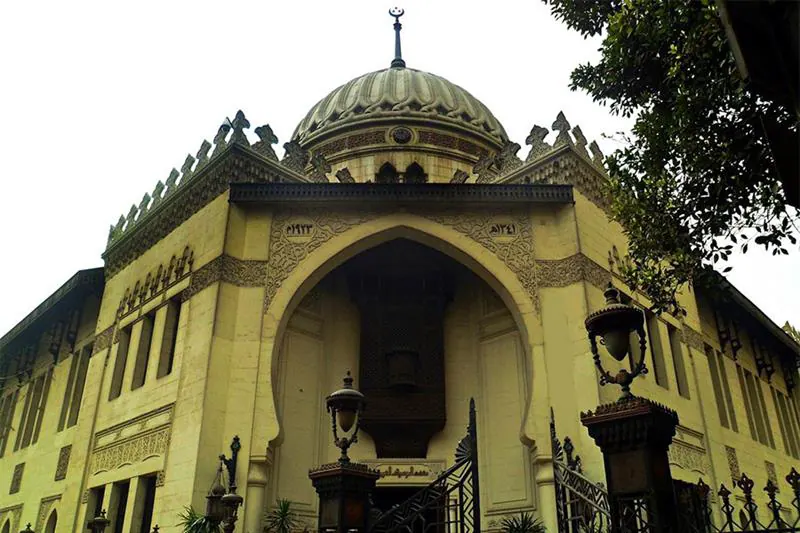
Located on Ramses Street in the heart of Cairo, the Arab Music Institute stands out as a serene oasis amidst the city's bustling streets. The building, over a century old, is an architectural archive that houses a rich history of traditional Arab music, with its beautifully painted ceilings, gilded Arabic inscriptions, and intricately carved ornamentation. As part of the Egyptian Opera House complex, the institute is home to a royal theatre, the museum of Mohamed Abdel Wahab, and the museum of historic musical instruments. The institute's stunning architecture and historical significance have earned it a place on Egypt's Islamic heritage list.
The story of the Arab Music Institute began in the early 20th century, when a group of musicians and music enthusiasts, including Mustafa Bey Reda, sought to preserve and develop the Arab oriental musical tradition. Initially, they established a modest Oriental Music Club in a small building on Mohamed Ali Street around 1913-1914. However, as the initiative gained momentum, the government allocated land on Ramses Street for a permanent institution. A 1921 agreement provided approximately 2,000 square meters, with about 1,200 square meters designated for construction and the remainder for a garden.
The institute's building officially dates back to 1923, and its official ceremonial opening was held on 26 December 1929, in the presence of King Fouad I. However, Mohamed Manaa, the institute's general director, attributes its establishment to Queen Nazli, King Fouad's wife, and the renowned composer and artist Abdel Azim Abdel Haq. According to Manaa, Abdel Haq persuaded Queen Nazli to support Mustafa Bey Reda's efforts to preserve Arab music, and she subsequently donated a piece of land from her own property for the institute.
The Arab Music Institute's architecture is a testament to its musical heritage, drawing strongly on Islamic and Ottoman traditions. The building's design combines historical Egyptian forms with the work of Italian designers Ernesto Verucci and Paul Conin Pastier and Egyptian engineers, including Farag Amin. The entrance is framed by a richly decorated wooden door with gilded ornamentation, topped by an arch and a wooden mashrabiya. The building's most distinctive feature is its large dome, crowned by a copper crescent incorporating the three stars of the emblem of the Egyptian Kingdom.
The institute played a significant role in the international study of Arab music, hosting the First Congress of Arab Music in 1932. This event brought together musicians and specialists from Egypt and around the world, solidifying the institute's position as a hub for Arab music preservation and education. The institute's impact on Arab music is evident in the presence of great singers such as Abdel Halim Hafez, Farid Al-Atrash, and Mohamed Abdel Muttalib, as well as prominent composers like Kamal El-Tawil and Baligh Hamdi.
The institute's corridors and classrooms were once part of the daily musical life, witnessing the presence of renowned artists and composers. Many composers, including Baligh Hamdi, were discovered through the institute's informal musical life. Artists visiting the institute would sometimes hear them humming or playing, be struck by their talent, and invite them to work on new compositions. The institute's walls also feature rare photographs of some of Egypt's most celebrated early singers and composers, including Almaz, Abdo El-Hamouli, Zakariya Ahmed, and Mahmoud El-Sherif.
Today, the Arab Music Institute continues to be a vital part of Cairo's musical heritage, with its historic building and rich history attracting visitors from around the world. As Cairo prepares to host the 34th Arab Music Festival and Conference, the institute stands as a testament to the city's enduring musical legacy. The institute's preservation of traditional Arab music ensures that this rich cultural heritage will continue to thrive for generations to come.
Key points
- The Arab Music Institute was officially opened on 26 December 1929, in the presence of King Fouad I.
- The institute hosted the First Congress of Arab Music in 1932, bringing together musicians and specialists from Egypt and around the world.
- The institute's architecture reflects its musical heritage, drawing strongly on Islamic and Ottoman traditions.