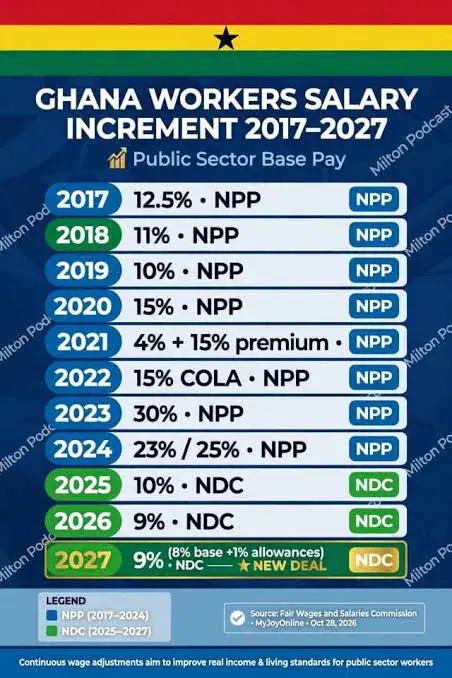
A recent debate on Ghana's public sector remuneration issue was aired on GBC News, featuring Prince from the governing NDC and Abdullah from the opposition NPP. The discussion centered around the newly agreed 9% and 10% increase in public sector wages, set to be implemented over a two-year period with a freeze on further adjustments. This wage increase has sparked a national conversation about whether it will protect the purchasing power of Ghanaian workers.
According to Prince, the NDC's representative, wage negotiations must consider macroeconomic realities, including government revenue generation, inflation trends, and public finance sustainability. He noted that past inflation spikes have significantly impacted household incomes but pointed to recent stabilization efforts, such as moderated inflation and restrained utility tariff increases. Prince emphasized that the government's approach aims to balance fiscal sustainability with relief for workers.
Prince addressed the issue of food and commodity prices, referencing market monitoring reports that compare baseline costs between August and September. He acknowledged that staple items like onions, tomatoes, and cooking oil continue to strain family budgets but argued that targeted government interventions are working to cushion consumers from market volatility. The structure of the two-year deal, with staggered increases, was guided by projected inflation targets for 2027 and 2028.
Abdullah, representing the NPP, offered a contrasting view, arguing that the 9% and 10% adjustments are insufficient to restore what public sector workers have lost to inflation and currency depreciation. He challenged the narrative of economic recovery by comparing current cost-of-living pressures with historical wage actions during periods of severe national crisis. Abdullah stated that cumulative adjustments during prior challenging cycles far outpaced the single-digit increases proposed.
The opposition's critique hinges on the gap between macroeconomic claims and market realities. Abdullah emphasized that the government's proposal does not adequately address the needs of public sector workers, who have been significantly impacted by economic challenges. He called for a more substantial adjustment to ensure that workers' purchasing power is protected.
The debate highlights the complexities of balancing fiscal sustainability with the need to support public sector workers in Ghana. While the government aims to prevent unsustainable promises, the opposition argues that more needs to be done to address the current cost-of-living pressures. The proposed wage increases will be implemented over the next two years, with a review of their impact on the economy and workers.
The wage increase has been a critical topic of discussion in Ghana, with various stakeholders weighing in on its potential impact. The government's efforts to stabilize the economy and support workers are ongoing, but the debate is far from over. As the country moves forward, it remains to be seen how the proposed wage increases will affect the lives of public sector workers and the broader economy.
Key points
- The Ghanaian government has agreed to a 9% and 10% increase in public sector wages over two years.
- The opposition argues that the wage increases fall short of restoring what public sector workers have lost to inflation and currency depreciation.
- The debate highlights the challenges of balancing fiscal sustainability with the need to support public sector workers in Ghana.