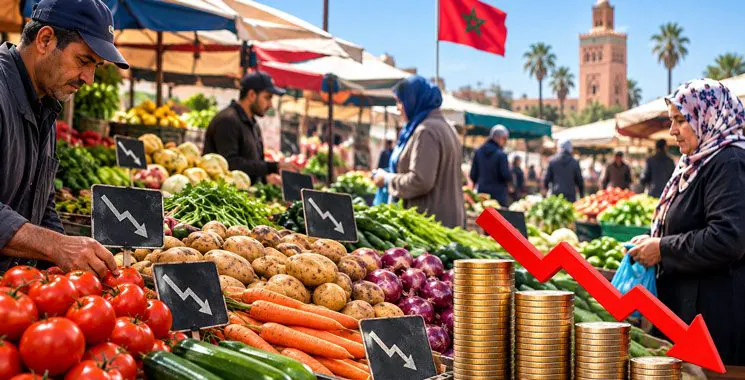
Morocco's inflation rate has continued to ease, dropping to -0.6% in July from 1.1% in the second quarter. This decline is primarily attributed to the decrease in food prices and the slowdown in fuel price increases, set against a backdrop of declining international oil prices. According to the policy report released by Bank Al-Maghrib, the country's central bank, this trend is expected to persist into the third quarter.
The report highlights that the inflation rate is anticipated to average -0.3% in the third quarter, largely due to a 4.7% decline in volatile food product prices, following a 3.8% increase in the previous quarter. Additionally, fuel prices are expected to rise by 22.4% in the third quarter, down from 26.6% in the second quarter, reflecting the evolution of international oil product prices.
The inflation rate for the first nine months of the year shows a slight easing of the underlying inflation indicator, which is expected to stand at -0.2% in the third quarter. This indicator had decreased to -0.3% in July, after a -0.4% decline in the second quarter. The central bank attributes this development to a moderation in the decline of food prices, specifically noting a 0.3% increase in the price of table oil.
The prices of products and services, excluding food, within the underlying inflation indicator, increased by 1.7% in July, compared to 1.6% in the second quarter. This rise was mainly driven by a slowdown in the growth of jewelry prices, from 54.9% to 43%. An analysis of the underlying inflation indicator by Bank Al-Maghrib reveals that the easing of its decline is entirely due to an acceleration in the growth of non-tradable goods and services prices.
According to the central bank's survey of industrialists in July 2026, 68% of respondents expect inflation to stabilize over the next three months, while 30% anticipate an increase and 1% foresee a decrease. Moreover, financial sector experts surveyed by Bank Al-Maghrib expect an inflation rate of 2.1% on average over the next eight quarters, slightly down from 2.2% in the second quarter.
The experts also maintained their inflation expectations at 2.2% over the 12-quarter horizon, unchanged from the previous quarter. They believe that future inflation will be influenced by global commodity prices excluding oil, pump prices, and inflation in partner countries. In a related development, producer prices in the manufacturing sector, excluding oil refining, rose by 0.1% in July 2026.
This monthly increase reflects rises of 0.2% in the food industry and the manufacture of other non-metallic mineral products, as well as a 0.9% increase in metallurgy. Conversely, prices fell by 0.1% in the chemical industry. On an annual basis, producer prices, excluding oil refining, increased by 0.9% in July, following a 0.7% rise the previous month.
Key points
- Morocco's inflation rate is expected to average -0.3% in the third quarter of 2026.
- The decline in inflation is primarily driven by decreases in food prices and slower increases in fuel prices.
- The underlying inflation indicator is expected to stand at -0.2% in the third quarter, reflecting a slight easing in inflationary pressures.