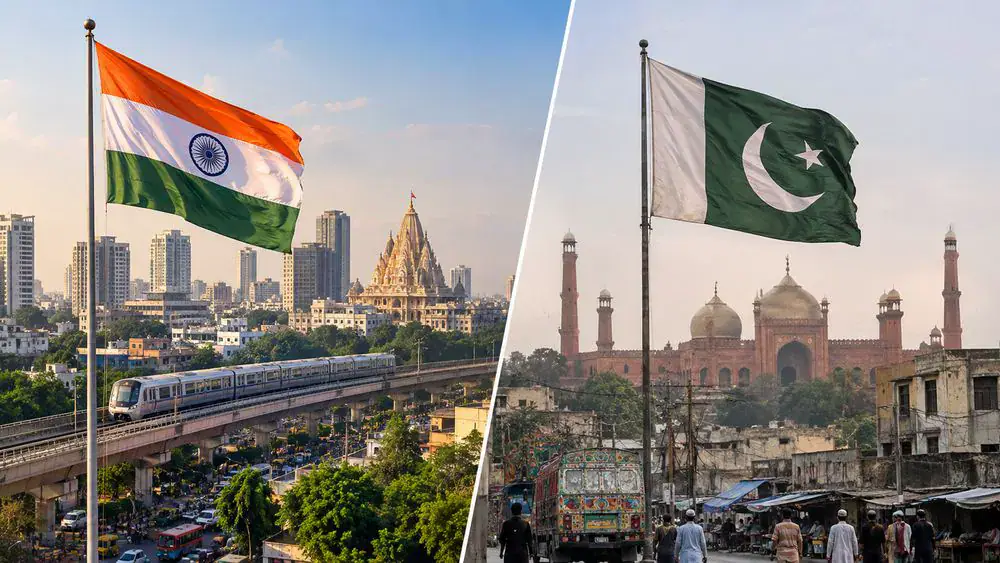
India and Pakistan, born from the 1947 Partition, have followed divergent economic paths, highlighting the challenges of poverty reduction, political stability, and national development. The World Bank's October 2026 Poverty and Equity Brief reports that India's extreme poverty rate declined from 27.1% in 2011 to 2.6% in 2023. This significant reduction in poverty has been accompanied by a decline in the proportion of the population living below the lower-middle-income poverty threshold of US$4.20 a day, from 57.7% to 16.1%.
India's progress is particularly notable given its complex historical inheritance. The country's modern political boundaries emerged from centuries of conquest, religious transformation, colonial extraction, and territorial fragmentation. Its history encompasses Arab incursions, successive imperial expansions, European commercial ambitions, British colonial domination, and the traumatic Partition of 1947. This complex history has presented significant challenges for India's development, making its poverty reduction achievements all the more remarkable.
The Indian subcontinent was a significant centre of global commerce, manufacturing, and intellectual achievement long before European colonial expansion. Its textiles, spices, craftsmanship, agricultural production, and other commodities were sought after across international trading networks. However, India's history of external conquest did not begin with Europe. Arab Muslim merchants had established trading connections with parts of the Indian coast before Arab military forces conquered Sindh in 711–712 CE under Muhammad bin Qasim.
A compelling dimension of India's poverty reduction is its comparison with Pakistan's experience. Both countries emerged from the British Partition of India in 1947, inherited interconnected histories, and faced the enormous responsibility of building modern states out of the British colonial inheritance. However, their developmental trajectories have increasingly diverged. Pakistan was founded on the political proposition that a shared Islamic identity could provide the basis for a separate nation, while India retained a pluralistic constitutional framework.
The distinction between India and Pakistan does not mean India has escaped tensions, communal violence, or identity-based politics. Nor does it mean Pakistan's developmental difficulties can be explained by religion alone. Rather, their experiences raise an important question about the relationship between national identity, institutional stability, and economic development. Pakistan's successive military interventions, political instability, weak job creation, fiscal pressures, and limited growth in labour productivity have complicated its efforts to establish sustained economic progress.
The World Bank reports that about 3.5 million people enter Pakistan's workforce annually, while employment creation has struggled to keep pace. India's challenges are equally substantial, particularly unemployment, inequality, informality, and uneven regional development. Nevertheless, its sustained investment in infrastructure, agriculture, industrial capacity, technology, and financial inclusion has accompanied a remarkable reduction in poverty. There are lessons for both countries, with Pakistan requiring stronger civilian institutions, greater productive investment, economic diversification, and an employment strategy capable of absorbing its growing population.
India's greatest opportunity lies in recognising that the two countries' shared geography and historical connections need not remain defined by the borders established through Partition. Greater regional trade, economic cooperation, infrastructure connectivity, and the exchange of knowledge could benefit populations on both sides of the border. For Africa, India's developmental transformation offers an important point of reflection, with both regions experiencing similar challenges related to histories of external and religious conquest, colonial boundaries, resource extraction, and economies structured to serve interests beyond their borders.
Key points
- India's poverty reduction offers valuable lessons for Africa and Pakistan.
- India's experience invites examination of what becomes possible when historical inheritance is confronted through sustained investment in productive capacity, institutions, and economic opportunity.
- Pakistan's developmental future requires stronger civilian institutions, greater productive investment, economic diversification, and an employment strategy capable of absorbing its growing population.
Reporting sources
- India’s poverty reduction offers lessons for Africa and Pakistan · Pretoria News