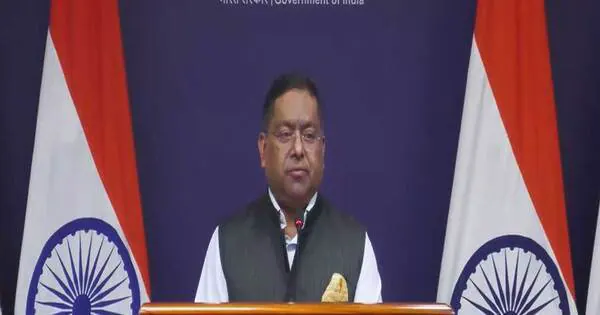
The Ministry of External Affairs (MEA) of India has stated that the suspension of the Permanent Labor Certification (PERM) programme by the US government does not impact the validity of existing H-1B visas or the status of visa holders and their dependents. MEA spokesperson Randhir Jaiswal emphasized that the PERM programme is distinct from the H-1B visa programme, and the suspension of PERM applications will not directly affect existing H-1B visas.
The US Department of Labor suspended certain major technology and IT outsourcing companies from the PERM programme, citing multiple active federal investigations. The companies named included Cognizant, Infosys, Tata, Wipro, HCL, Capgemini, Microsoft, and Adobe. US Labour Secretary Keith Sonderling announced that the department would neither accept new applications nor process pending permanent labour certification applications involving these companies.
The US Labour Secretary alleged that the suspended companies had collectively sought millions of foreign workers and received hundreds of thousands of H-1B visa approvals and permanent labour certifications. Since 2009, these companies have requested almost 3 million foreign workers, received over 230,000 H1B Visa approvals, and over 100,000 permanent labor certifications. The MEA clarified that the suspension could have implications for eligible employees seeking permanent residency in the United States.
The MEA criticised remarks made by US Vice President JD Vance targeting foreign workers, describing the characterisation of Indian professionals as 'unwarranted' and 'deeply offensive'. Jaiswal stated that Indian professionals in the United States are highly educated and skilled contributors to its economy and innovation ecosystem. The MEA spokesperson also invoked the contribution of immigrants to America's economic development.
Vance's remarks came during a press conference on efforts to combat visa fraud, where he alleged that the H-1B visa programme had become vulnerable to widespread abuse. He specifically targeted Microsoft, alleging that the company had laid off American workers while benefiting from thousands of H-1B visas and green cards. Vance described foreign workers as 'foreign indentured servants' and argued that companies operating in the United States should prioritise American workers.
The MEA expressed concern over the US decision, emphasising that the movement of skilled professionals benefits both India and the United States by supporting innovation, research, productivity, and job creation. Jaiswal noted that talent mobility adds value to both economies, creating opportunities for Indians and helping US companies with cutting-edge talent.
The MEA stated that the measures announced by the US government do not support the shared objectives of the two countries. India will continue to monitor developments concerning the issue. The ministry reiterated that the suspension of PERM applications and the H-1B visa programme are distinct matters, while cautioning that the decision could affect the permanent-residency process of eligible employees at the companies concerned.
Key points
- The US suspension of the PERM programme does not affect H-1B visa validity.
- The MEA criticised US Vice President JD Vance's remarks targeting foreign workers.
- The movement of skilled professionals benefits both India and the United States.