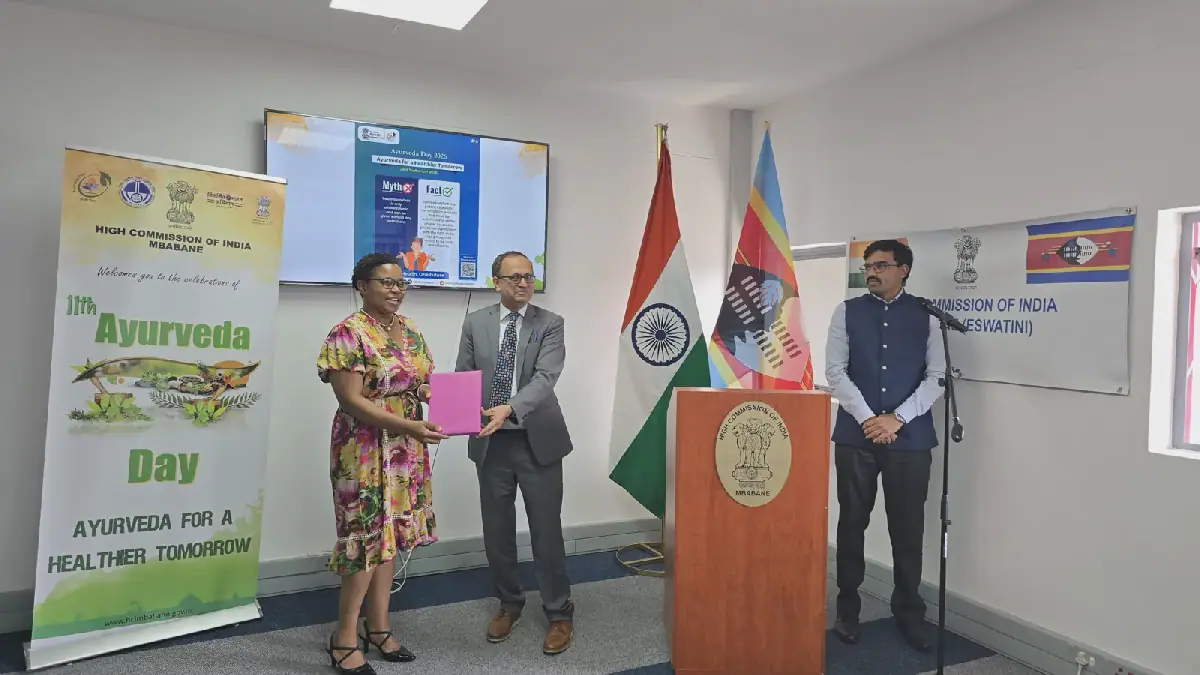
The High Commission of India in Mbabane recently marked the 11th Ayurveda Day, calling for greater cooperation between India and Eswatini in traditional medicine, wellness, and preventive healthcare. The event, held under the theme "Ayurveda for a Healthier Tomorrow," focused on the role of Ayurveda in promoting holistic approaches to health and responding to emerging global health challenges. This celebration highlights the potential for collaboration between the two nations in the area of traditional medicine.
India's Chargé d'Affaires, Shri Ajay Kumar Sharma, addressed guests at the event, including representatives from the World Health Organisation, the University of Eswatini, and other stakeholders. Sharma emphasized that Ayurveda could contribute to discussions around preventive healthcare, healthy lifestyles, and sustainable living. He noted that India and Eswatini could share knowledge and expertise in traditional medicine, leveraging their rich traditions of knowledge relating to medicinal plants, nutrition, and natural resources.
The theme "Ayurveda for a Healthier Tomorrow" represents a vision for the future, according to Sharma. It encourages exploring how traditional knowledge and scientific innovation can complement each other to address emerging health challenges. Ayurveda, India's ancient system of holistic healthcare, is rooted in the principle that health is not merely the absence of disease but a state of balance and harmony between the body, mind, lifestyle, and environment.
Ayurveda, which translates to the "science of life," emphasizes prevention, healthy living, nutrition, physical activity, mental wellbeing, and harmony with nature. This philosophy is particularly relevant today, as the world faces increasing challenges from lifestyle-related diseases, stress, and unhealthy dietary habits. The internationalisation of Ayurveda aims to explore how traditional knowledge and modern science can complement each other for the benefit of humanity.
The event highlights the potential for cooperation between India and Eswatini in traditional medicine and wellness. Both countries enjoy warm and friendly relations, characterised by cooperation in several areas, including healthcare, capacity building, education, and human resource development. This cooperation can be further explored to address emerging health challenges and promote holistic approaches to health.
The World Health Organisation and the University of Eswatini were represented at the event, indicating a growing interest in Ayurveda and traditional medicine. The Senior Lecturer at the University of Eswatini, Ms Dr Thabile Ndlovu, and other stakeholders were in attendance, demonstrating the potential for collaboration and knowledge sharing between India and Eswatini in the area of traditional medicine.
The 11th Ayurveda Day celebration in Mbabane marks a significant step towards promoting cooperation between India and Eswatini in traditional medicine and wellness. The event has set the stage for future collaborations and knowledge sharing between the two nations, with a focus on promoting holistic approaches to health and responding to emerging global health challenges.
Key points
- India and Eswatini explore cooperation in traditional medicine and wellness
- Ayurveda Day celebration promotes holistic approaches to health
- India and Eswatini have rich traditions of knowledge relating to medicinal plants and natural resources