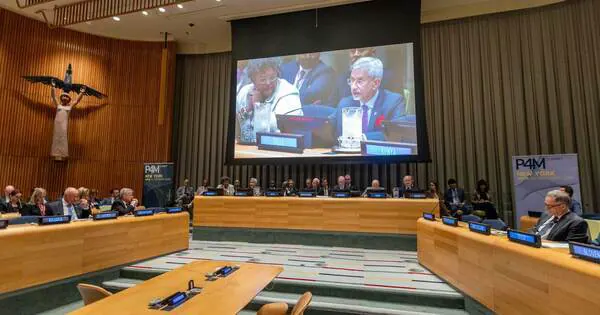
The Partners for Multilateralism (P4M) initiative was launched on September 21 on the margins of the United Nations General Assembly High-Level Week by the European Union, along with co-sponsors Australia, Barbados, Brazil, Canada, India, and Kenya. The initiative aims to promote peace, stability, inclusive and sustainable development, and rights for all, while committing to reform and strengthen the multilateral system. The co-sponsors adopted the Declaration of the Partners for Multilateralism (P4M) Summit, describing it as a joint commitment to multilateralism, international law, peace, and prosperity.
The declaration noted that the world is undergoing profound transformation, with growing polarisation, conflicts, violations of international law, and increasing reliance on power politics, protectionism, and coercion posing challenges to international cooperation. The signatories said these developments threaten international peace and security at a time when stronger global cooperation is increasingly necessary. They also pointed to disruptions in trade, supply chains, investment, and development finance, while highlighting shared challenges such as climate change, biodiversity loss, pollution, and the rapid development of emerging technologies.
The co-sponsors committed to work together in support of peace, stability, inclusive and sustainable development, shared prosperity, human dignity, and rights for all. The declaration reaffirmed the importance of the multilateral system established under the United Nations Charter, while stressing the need to reform it so that it is more effective, representative, inclusive, and suited to current global challenges. The signatories also reaffirmed their commitment to international law and principles, including sovereign equality, territorial integrity, peaceful settlement of disputes, and the prohibition of the threat or use of force.
The declaration underlined the importance of international humanitarian law, the Universal Declaration of Human Rights, and the protection of human rights and fundamental freedoms. It also reaffirmed the signatories' commitment to implementing major international agreements and frameworks, including the Paris Agreement and the 2030 Agenda for Sustainable Development. The P4M co-sponsors highlighted rising inequalities within and among countries as a challenge to stability, social cohesion, and inclusive growth.
The declaration called for stronger multilateral cooperation that is open, fair, equitable, inclusive, networked, and practical, including closer partnerships with regional organisations and support for regional integration. A major focus of the initiative is reform of multilateral institutions, particularly the United Nations. The co-sponsors agreed to reform and strengthen multilateral institutions, including through initiatives such as UN80, with the aim of improving their ability to prevent conflicts, respond to crises, and deliver sustainable development.
The declaration also called for fair, open, resilient, predictable, and inclusive economic cooperation. Areas identified for greater cooperation included resilient global supply chains, reform of the multilateral trading system, international financial architecture, digital transformation, artificial intelligence, climate change, and global health. The signatories committed to regular exchanges with partners from all regions to promote dialogue, coordination, and practical cooperation.
European Council President Antonio Costa stated that international law, effective multilateralism, and cooperation are essential in addressing global challenges. The co-sponsors concluded the declaration by choosing cooperation, respect for international law, multilateralism, and shared responsibility as the foundations of their collective efforts at a time of mounting pressure on the international order. The P4M initiative aims to promote a more effective, representative, and inclusive multilateral system.
Key points
- The Partners for Multilateralism initiative aims to promote peace, stability, and multilateral reform.
- The co-sponsors committed to work together in support of peace, stability, inclusive and sustainable development, and rights for all.
- The declaration called for stronger multilateral cooperation and reform of multilateral institutions.