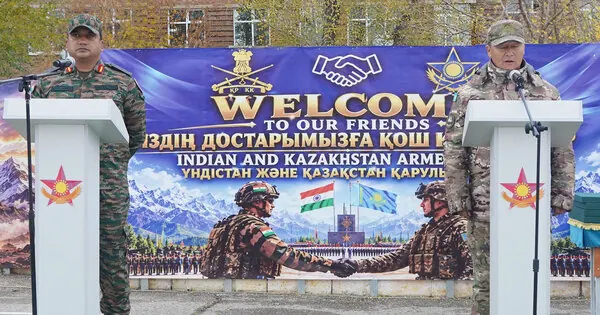
The India-Kazakhstan Joint Military Exercise KAZIND-2026 came to a close on October 11 at Oskemen, Kazakhstan, after a successful 72-hour validation drill. The exercise, which began on September 28, aimed to enhance interoperability and strengthen the joint capabilities of the Indian and Kazakh armed forces to undertake counter-terrorism operations. The validation exercise tested the ability of the participating contingents to undertake joint counter-terrorism operations in a simulated operational environment.
The 72-hour validation exercise marked the culmination of the progressive training conducted during the exercise. The exercise was witnessed by India's Ambassador to Kazakhstan, YK Sailas Thangal, and Major General Zhenis Maralov, Chief of Regional Command East of the Armed Forces of Kazakhstan. Sailas Thangal presided over the closing ceremony, congratulating both contingents on the successful conduct of the exercise and commending their professionalism, dedication, and commitment to joint training.
Exercise KAZIND-2026 focused on counter-terrorism operations in semi-urban and mountainous terrain. The activities included responses to simulated terrorist actions, raids, search-and-destroy missions, and cordon-and-search operations. The training also involved tactical navigation, weapon handling, tactical drills, and small-arms live firing. A Joint Command Post and an Intelligence and Surveillance Centre were established to facilitate collaborative planning, information sharing, and coordinated decision-making between the participating forces.
The exercise also focused on joint planning and execution, air mobility, and the integrated employment of unmanned aerial systems and counter-unmanned aerial system capabilities. Training activities were designed to help both contingents exchange operational experience and develop a shared understanding of tactics, techniques, and procedures. The participating troops took part in activities aimed at strengthening camaraderie and mutual understanding, including an Army Martial Arts Routine (AMAR) session, a joint yoga session, and sporting activities.
The Indian contingent participated in an intensive training programme alongside their Kazakh counterparts. The programme included various activities designed to foster teamwork, friendship, and mutual respect among the personnel of both countries. The successful conclusion of KAZIND-2026 reaffirmed the longstanding defence partnership between India and Kazakhstan and their shared commitment to strengthening military cooperation, regional peace, stability, and collective security.
The ninth edition of the exercise demonstrated the strong bilateral defence ties between the two nations. The exercise was conducted in a spirit of friendship and cooperation, with both contingents displaying a high level of professionalism and commitment to the training. The participating troops demonstrated their ability to apply the tactics and procedures rehearsed during the exercise against a simulated terrorist threat.
The India-Kazakhstan Joint Military Exercise KAZIND-2026 has once again showcased the strong defence partnership between the two nations. The exercise has contributed significantly to enhancing the interoperability and joint capabilities of the Indian and Kazakh armed forces. The successful conclusion of the exercise has set the stage for future collaborations between the two nations in the field of defence and security.
Key points
- The India-Kazakhstan Joint Military Exercise KAZIND-2026 concluded successfully at Oskemen, Kazakhstan, with a 72-hour validation drill.
- The exercise aimed to enhance interoperability and strengthen the joint capabilities of the Indian and Kazakh armed forces to undertake counter-terrorism operations.
- The successful conclusion of KAZIND-2026 reaffirmed the longstanding defence partnership between India and Kazakhstan and their shared commitment to strengthening military cooperation.