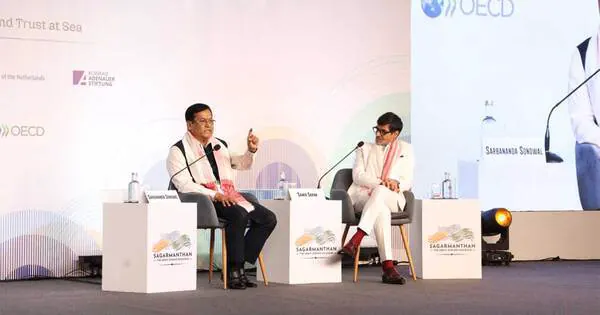
India is hosting the third edition of the Sagarmanthan: The Great Oceans Dialogue 2026, a three-day event that brings together over 1,200 ministers, policymakers, industry leaders, and scholars from more than 70 countries. The dialogue, jointly hosted by the Observer Research Foundation (ORF) and the Ministry of Ports, Shipping and Waterways (MoPSW), focuses on "Blue Geographies, New Aspirations: Trade, Technology, and Trust at Sea." The discussions centered on the maritime landscape being reshaped by geopolitical tensions, supply-chain disruptions, climate change, and the concentration of global shipbuilding capacity.
Minister of Ports, Shipping and Waterways Sarbananda Sonowal emphasized that India's maritime transformation is being supported by investments in ports, shipbuilding clusters, and maritime training. He linked the government's approach to the Maritime India Vision 2030 and Maritime Amrit Kaal Vision 2047. Sonowal stated that the government's maritime programs aim to expand the sector's capacity and develop a skilled workforce for India and the global economy. The minister highlighted the importance of the seas and oceans in creating bonds of friendship among nations.
Shantanu Thakur, Minister of State for Ports, Shipping and Waterways, underscored the urgency of strengthening maritime resilience. He pointed to the vulnerabilities created by geopolitical tensions at major maritime chokepoints, citing the recent Strait of Hormuz crisis. Thakur emphasized that the oceans are central to global growth, prosperity, security, and sustainability. He stressed that disruptions to maritime routes have far-reaching effects, making it essential to develop alternative trade corridors.
Rizwan Soomar, CEO and Managing Director of DP World - Subcontinent, Central Asia, Levant, and Egypt, highlighted the shift in businesses' approach to supply-chain continuity. He stated that companies are moving away from an exclusive focus on efficiency towards building redundancy into their supply chains. Soomar emphasized the need for alternate trade corridors to be institutionalized, commercialized, and operationalized, even in good times, to ensure business continuity during challenging times.
India's maritime infrastructure expansion was a major focus of the opening day's discussions. Vijay Kumar, Secretary, Ministry of Ports, Shipping and Waterways, pointed to the growth in cargo handled by India's major ports over the past decade. He noted that cargo handled by major ports rose from 581 million tonnes in 2014-15 to over 915 million tonnes in 2025-26. Kumar also highlighted the reduction in ship turnaround time and the upcoming development of the Vadhavan Port, which will be among the ten largest ports in the world.
The issue of concentration in global maritime infrastructure was raised during the inaugural ministerial plenary. Former Australian Prime Minister and Global President and Chief Executive Officer of Asia Society Kevin Rudd emphasized that countries in the Indo-Pacific are looking at maritime infrastructure through the lens of long-term economic resilience. Rudd highlighted the risks associated with concentration and monopoly control, stressing the need for investments in shipbuilding and port infrastructure.
The dialogue also highlighted the transformation of shipping as the industry faces pressure to reduce emissions while maintaining global trade. The first day saw the launch of the India-EU Green Shipping Corridor, as well as discussions on sustainable blue economies with the Organisation for Economic Co-operation and Development (OECD). Other sessions examined India's maritime links with Korea, the India-Middle East-Europe Economic Corridor (IMEC), and the potential for alternative trade routes connecting major markets.
Key points
- India is seeking to strengthen its maritime infrastructure, shipping capacity, and alternative trade corridors to address vulnerabilities in the international maritime system.
- The Sagarmanthan 2026 dialogue brings together over 1,200 stakeholders from more than 70 countries to discuss maritime resilience and cooperation.
- India's maritime strategy is tied to the development of shipbuilding, logistics, and maritime skills, with a focus on expanding port capacity and strengthening its position in international supply chains.