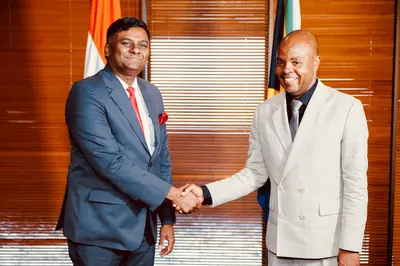
India and Mpumalanga province have strengthened their economic ties, building on existing trade relationships in resources, agriculture, tourism, renewable energy, and digital skills. A recent high-level engagement in Mbombela, led by India's Consul General in Johannesburg, Sh. S. Koventhan, aimed to identify areas for deeper cooperation and new partnerships. The visit included a delegation-level meeting with Premier Mandla Ndlovu, a "Doing Business with India" seminar, and a networking dinner with Indian businesses.
The economic relationship between India and Mpumalanga has firm foundations, with coal connecting the province's mining economy with Indian industry. Wood pulp and forestry products form another important commercial link, while Indian travelers contribute to the province's tourism sector. Mpumalanga's coal industry illustrates the established relationship, with the provincial investment agency identifying India as a key destination for coal exports. These transactions connect mining, transport, and related services in Mpumalanga with industrial demand in India.
Forestry offers a further connection between India and Mpumalanga, with the province exporting pulp, paper, and specialized cellulose. Sappi's Ngodwana Mill produces dissolving wood pulp and paper products, providing a foundation for deeper engagement with Indian buyers and manufacturers. The significance of these links extends beyond commodities, providing a starting point for discussions on processing, machinery, technology, logistics, and local supplier development. Indian companies familiar with buying from South Africa can also become partners in expanding productive capacity within the province.
Agriculture offers considerable scope for diversification, with Mpumalanga's Lowveld being an important citrus-producing region. Citrus, berries, and other high-value horticultural products merit closer attention in developing connections with Indian importers, distributors, and retailers. Realizing this opportunity requires work across the supply chain, including product-specific market access, quality standards, dependable volumes, cold storage, and transport. Partnerships in post-harvest technologies could strengthen producers' competitiveness while creating opportunities for Indian equipment and technology providers.
The visit also explored opportunities in mining, ICT, skills development, renewable energy, and tourism. For mining, potential cooperation extends to equipment, engineering, maintenance, processing, and digital systems. Local partnerships in these areas could create opportunities for provincial suppliers and technical workers while helping Indian businesses establish a stronger industrial presence. Renewable energy adds a forward-looking dimension, with India's experience in conventional power systems and expanding renewable technologies providing a basis for technical and commercial exchanges.
The Consul General announced several initiatives to strengthen the partnership, including two Indian Council for Cultural Relations (ICCR) scholarship slots for candidates from Mpumalanga and Indian Technical and Economic Cooperation (ITEC) training slots for provincial officials. He also announced 24-hour business-visa facilitation for eligible business applicants from the province, subject to applicable requirements. These measures give the partnership a direct human dimension, opening educational pathways, strengthening provincial institutions, and facilitating business mobility.
The "Doing Business with India" seminar and networking dinner brought together representatives of 18 Indian businesses, five MECs, and three mayors, highlighting opportunities for two-way business development. Mpumalanga enterprises could explore India as a market, sourcing base, and investment destination, while Indian businesses examined opportunities within the province. The MEC for Economic Development and Tourism welcomed the initiative, expressing support for advancing cooperation and proposing joint teams in mining and ICT.
Key points
- India and Mpumalanga province have strengthened their economic partnership, exploring new frontiers in trade, investment, and technology.
- The partnership aims to deepen existing trade relationships and create new opportunities in resources, agriculture, tourism, renewable energy, and digital skills.
- The two sides have identified areas for cooperation in mining, ICT, skills development, renewable energy, and tourism, with a focus on joint teams and knowledge sharing.