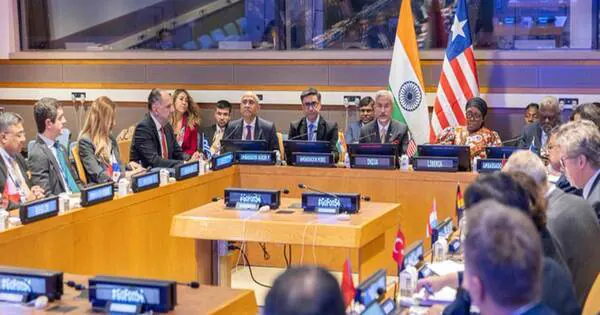
India and Liberia have launched an international coalition to champion maritime safety in response to a series of "unacceptable attacks" on commercial shipping and merchant marines. The coalition, announced by External Affairs Minister S Jaishankar and Liberian Foreign Minister Sara Beysolow Nyanti, aims to promote stability and confidence in the maritime sector. Jaishankar emphasized that these attacks are "legally and morally indefensible" and must stop.
The coalition brings together major ship-owning countries, prominent registry holders, and leading suppliers of the global maritime workforce. Jaishankar noted that India, as a major source country for seafarers, has joined hands with Liberia, which hosts the largest shipping registry by tonnage. The two countries will work together to shape maritime policy, raise operational standards, and safeguard the men and women at sea.
The recent attacks on shipping have spanned from the Strait of Hormuz and the Gulf to the Red Sea and the Black Sea, with no justification for them. Jaishankar highlighted the urgency of the initiative, citing the threat to the basic needs of the international community, including food, fuel, fertilizer, and financial services. He warned that these attacks are "threatening the basic needs of the international community."
The coalition has three "non-negotiable goals": demanding uncompromising technical standards, stringent vessel compliance, and coordinating environmental stewardship; defending commercial sea lanes against piracy, armed attacks, regional instability, and asymmetric threats; and centering the human beings who keep our world running. Nyanti emphasized that seafarers must never be treated as expendable cargo.
Jaishankar detailed recent casualties, including the death of an Indian sailor on an Antigua and Barbuda-flagged bulk carrier, MV Cape Dove, in the Gulf of Oman, and the disappearance of an Indian crew member on a Panama-flagged oil tanker, El Gaya, in the Strait of Hormuz. He noted that these incidents are no longer exceptional occurrences.
The coalition will function as a collaborative platform for nations engaged in shipping, registration, and crewing. Jaishankar stressed that a unified governmental response is imperative, given that a vessel's flag and its crew members' nationalities frequently differ. The coalition will work within the framework of the International Maritime Organization and International Labor Organization.
Maritime shipping accounts for four-fifths of global trade, surpassing USD 35 trillion last year, with two million individuals employed in the maritime sector. The coalition's initiative aims to add to the factors of stability and confidence in an uncertain and perilous world.
Key points
- The coalition aims to promote stability and confidence in the maritime sector.
- The recent attacks on shipping have spanned multiple regions, including the Strait of Hormuz and the Gulf.
- The coalition has three main goals, including demanding technical standards and defending commercial sea lanes.