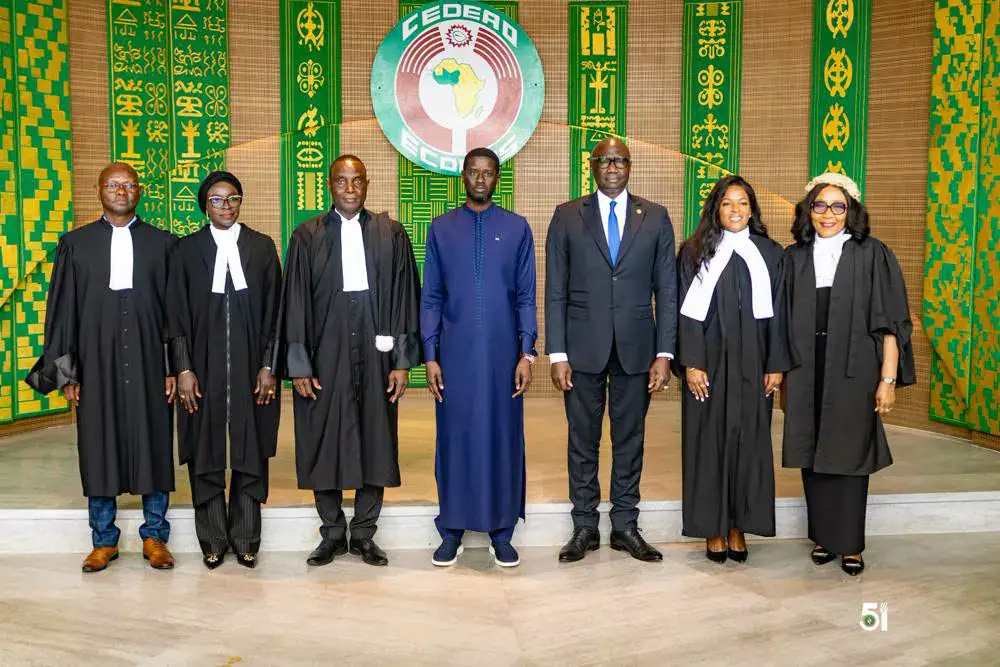
The ECOWAS Court of Justice, established in 1991, is a crucial tool for integration in West Africa, allowing citizens of member states to file complaints without exhausting domestic remedies. The court has jurisdiction over human rights violations, and its judgments are binding and enforceable. However, the execution of these judgments remains a significant challenge. On October 6, 2026, new judges were sworn in, marking the beginning of a four-year term. The court's accessibility is a significant advantage, with no requirement for legal representation or payment.
The ECOWAS Court of Justice has been hailed as a game-changer for human rights in West Africa. According to Dr. Moustapha Fall, a public law lecturer at the University of Dakar, the court's procedures are flexible and democratic. The complainant simply needs to send a petition to the court's registry in Abuja, which is then communicated to the respondent state. The court then rules on the complaint, and if the violation is proven, it may award damages. This accessibility has led to the court being described as a "godsend" by lawyers and human rights defenders.
Despite the court's potential, the execution of its judgments remains a significant challenge. According to Anthony Anene-Maidoh, the former chief registrar of the court, only 18.5% of judgments have been enforced, with 37 out of 162 judgments executed in full or in part. Six countries, including Benin, Cabo Verde, and Guinea-Bissau, have not enforced any judgments. The Gambia has the highest enforcement rate, at 44.4%, followed by Senegal at 18.2% and Nigeria at 16.6%.
Obtaining a judgment from the ECOWAS Court of Justice is only the first step; enforcing it is often a significant challenge. Lawyers and human rights defenders have reported difficulties in enforcing judgments, particularly when they require changes to national laws or policies. The case of Karim Wade, who was awarded damages in 2016, is a notable example of a judgment that has not been enforced. Similarly, the case of Khalifa Sall, who was awarded damages in 2018, has also not been enforced.
The reluctance to enforce judgments is often due to a lack of political will or institutional capacity. According to Seydi Gassama, director of Amnesty International Senegal, some states have not designated an authority to oversee the execution of judgments. The recent withdrawal of Mali, Burkina Faso, and Niger from ECOWAS has also weakened the court's jurisdiction. Furthermore, some national courts view international judgments as an infringement on their sovereignty.
The ECOWAS Court of Justice faces significant challenges in enforcing its judgments. According to Dr. Moustapha Fall, some judgments require complex reforms, including changes to national laws or constitutions. The court's judgments are often seen as a challenge to national sovereignty, which can make enforcement difficult. Despite these challenges, the court remains a crucial tool for promoting human rights in West Africa.
The low rate of enforcement of ECOWAS Court of Justice judgments has significant implications for human rights in West Africa. If judgments are not enforced, it can create a "paper justice" system, where court rulings are not implemented in practice. This can undermine trust in the court and the integration process. To address this challenge, ECOWAS member states must prioritize the enforcement of court judgments and strengthen the court's institutional capacity.
Key points
- Only 18.5% of ECOWAS Court of Justice judgments have been enforced.
- The court's judgments are binding and enforceable, but execution remains a significant challenge.
- The reluctance to enforce judgments is often due to a lack of political will or institutional capacity.