Azazga, located about 30 kilometers east of Tizi-Ouzou, the capital of the Kabylie region, is renowned for its civic-minded residents, excellent restaurants, and delectable food. Paradoxically, the town is also home to a multitude of traditional healers and diviners, known as voyantes and cheikhs. These individuals claim to possess divine gifts and extraordinary spiritual powers, offering solutions to various life concerns, including social issues, illnesses, and misfortunes.
The town's residents and visitors can easily find these traditional healers, with multiple voyantes and cheikhs operating in each neighborhood. In the old village, or Tadarth, and the new town, or Tizi Bouchène, it is not uncommon to find at least one or two of these practitioners. By simply asking locals for directions, clients can easily locate the nearest voyante or cheikh. One such voyante, L'la Ouardia, has gained a reputation that extends beyond the town's borders, attracting a large following.
A visit to L'la Ouardia's residence reveals a crowded courtyard, with a dozen or so people waiting for their turn. The atmosphere is tense, similar to that found in hospital waiting rooms or medical offices. Interestingly, the majority of clients are young, urban women. One such client, Zohra, a French teacher, shares her story, explaining that she had been experiencing difficulties in her personal life, including a string of failed relationships.
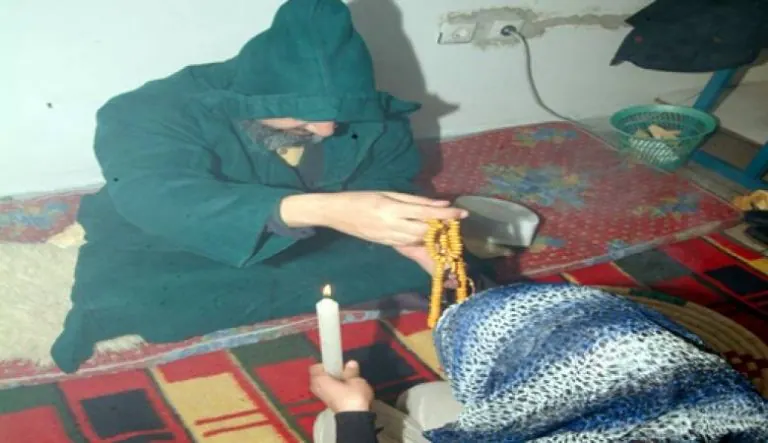
According to Zohra, L'la Ouardia helped her understand that she had been cursed since her adolescence, and that this curse was the root cause of her problems. Zohra claims to have benefited from L'la Ouardia's treatment, which includes a series of rituals and practices aimed at warding off the curse. Another client, Ferroudja, a 10-year-old married woman, has been struggling with infertility and has tried various treatments, including those prescribed by L'la Ouardia.
L'la Ouardia describes her role as a facilitator of trust between herself and her clients, likening her work to that of a psychologist. She asserts that her treatments are harmless and do not involve the use of black magic. Instead, she claims to be driven by a divine calling, which she has been aware of since childhood. Her calm and collected demeanor puts her clients at ease, even as they share their intimate struggles with her.
Another well-known figure in Azazga is a local cheikh, who operates from a converted family apartment. His clients, mostly individuals who believe they are possessed by evil spirits or cursed, seek his help in finding relief from their afflictions. Using a combination of Quranic recitations and other rituals, the cheikh claims to perform miracles, although the experiences of his clients vary widely.
The phenomenon of traditional healing and divination in Azazga raises questions about the intersection of spirituality and the law. While some, including local imams, view these practices as illicit, the law does not explicitly address the issue of voyance or sorcellerie. As a result, these practitioners operate with relative impunity, often charging exorbitant fees for their services.
Key points
- Many residents of Azazga and beyond are drawn to traditional healing and divination as a way to cope with life's challenges.
- These practices, often viewed as charlatanism by skeptics, continue to thrive in the region.
- The lack of clear legislation governing traditional healing and divination has created a gray area that practitioners exploit.