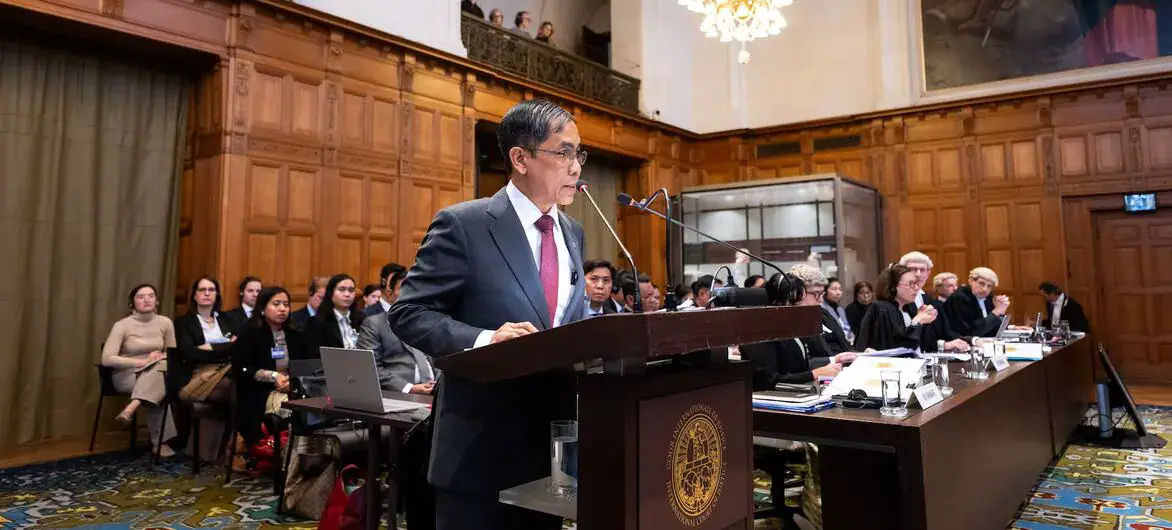
A recent landmark genocide ruling against Myanmar at the International Court of Justice (ICJ) has given South Africa new legal arguments in its case against Israel. The ICJ ruled on November 19 that Myanmar committed genocide against its Rohingya Muslim minority during military operations in 2017. The ruling established that genocidal intent must be the only reasonable inference from the evidence, but also that such intent can exist alongside other objectives, including military ones. This distinction is crucial for Israel, which claims its military campaign in Gaza was directed against Hamas, not Palestinians as a group.
The ICJ's ruling has divided legal experts and judges over how genocidal intent should be proved. The court found that Myanmar acted with the specific intention of physically destroying the Rohingya, in whole or in part, as an ethnic or religious group. Some experts, like Professor André Thomashausen, believe the ruling could work in Israel's favour, as the court maintained that genocidal intent must be the only reasonable inference from the evidence. Thomashausen doubts that such a finding can be made against Israel, citing the high standard required to prove genocide.
However, not all experts agree with Thomashausen's assessment. Anne Herzberg, legal adviser and UN representative for NGO Monitor, rejects the suggestion that the Myanmar judgment strengthens South Africa's case. She argues that the circumstances in Gaza are fundamentally different, citing Hamas's attacks on Israeli civilians, hostages taken into Gaza, and Hamas's extensive tunnel network. Herzberg also challenges the court's interpretation of genocidal intent, questioning how a state could comply with international humanitarian law and still be found to possess genocidal intent.
An analysis by Israeli international law scholars Yuval Shany and Amichai Cohen suggests that the implications for Israel may be more complicated. They argue that the Myanmar judgment has made genocide law less predictable by giving judges greater scope to assess the overall pattern of conduct. The scholars identified several issues that could affect South Africa's case, including how the court considers civilian displacement, damage to religious and cultural sites, statements by officials, and evidence from UN investigations.
The Myanmar case was brought by The Gambia in 2019 following military operations that forced hundreds of thousands of Rohingya to flee to neighbouring Bangladesh. The ICJ examined evidence of killings, serious bodily and mental harm, sexual violence, and measures intended to prevent births within the Rohingya population. Myanmar maintained that its operations were directed against insurgents, but the majority of ICJ judges concluded that the only reasonable inference from Myanmar's conduct was an intention to destroy a substantial part of the Rohingya group.
South Africa has welcomed the judgment, with the Department of International Relations and Cooperation stating that it would study the implications for other cases under the Genocide Convention, including ongoing proceedings. However, the outcome of South Africa's case against Israel, brought in December 2023, is not determined by the Myanmar ruling. The case will require a separate assessment of the evidence and the application of the Genocide Convention to the specific circumstances.
The ICJ's ruling has significant implications for the concept of genocide and its application in international law. The court's distinction between genocide and other serious international crimes, such as war crimes and crimes against humanity, is crucial. While the Myanmar ruling sets a precedent for the ICJ's approach to genocide cases, it also highlights the challenges of proving genocidal intent and the complexities of applying international law to specific circumstances.
Key points
- The ICJ's ruling against Myanmar establishes that genocidal intent must be the only reasonable inference from the evidence.
- Experts have differing views on the implications of the Myanmar ruling for South Africa's case against Israel.
- The ICJ's approach to genocide cases highlights the challenges of proving genocidal intent and the complexities of applying international law.
Reporting sources
- Myanmar genocide ruling’s impact on SA’s ICJ case · Jewish Report