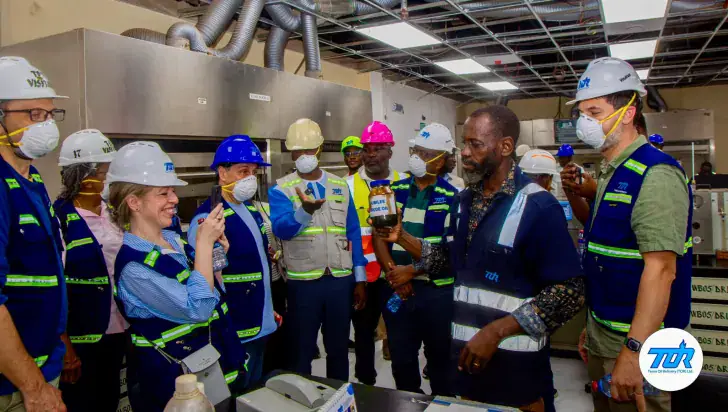
A delegation from the International Monetary Fund (IMF) recently visited Ghana's Tema Oil Refinery (TOR) to assess the refinery's recovery efforts and familiarize itself with its operations. The visit aimed to gain insight into management's efforts to restore the facility to sustained operational and financial stability. The IMF team was led by Country Resident Representative, Dr. Adrian Alter, while the TOR team was led by Managing Director, Edmond Kombat.
During the meeting, Mr. Kombat outlined the operational and financial challenges inherited by the current management, as well as measures introduced since May 2025 to restore confidence in the refinery's operations and revive its major processing plants. He mentioned that the new management had not received any investment from the government and had to rely on internally generated funds for all operations. The MD highlighted the management's priorities, including financial discipline, operational improvements, and rehabilitation of critical facilities.
The IMF team and TOR management discussed corporate governance and financial accountability, particularly efforts to clear a six-year backlog of unaudited accounts. The visit formed part of the IMF team's engagements with relevant government authorities and selected state-owned enterprises to understand their operations, financial positions, challenges, and contributions to the national economy. The discussions also covered the refinery's outstanding debt obligations to the government and possible restructuring.
Mr. Kombat disclosed that the refinery owed approximately $120 million to the government out of a total inherited debt of $517 million and was engaging the government over possible restructuring and reconciliation of historical financial commitments. The refinery is also in talks with other state institutions on similar outstanding obligations, with possible netting-off arrangements being considered. Despite the challenges, Mr. Kombat expressed optimism that the company could maintain profitability in subsequent years.
The TOR managing director mentioned that the company had recorded some profit last year and was considering a potential listing on the Ghana Stock Exchange to attract investment and provide additional capital for the refinery's operations and expansion. He also highlighted the refinery's contribution to domestic petroleum product availability, price stability, and the country's ability to withstand disruptions in the international petroleum market.
On the volume of crude oil processed by TOR, Mr. Kombat stated that the refinery had processed approximately five million barrels of crude oil, including about two million barrels sourced from Ghanaian fields. He expressed hope that the Ghana National Petroleum Corporation (GNPC) would make its full crude allocation available to TOR for refining by next year to improve feedstock availability and support more consistent refinery operations.
The IMF delegation later toured parts of the refinery to observe some of the rehabilitated facilities and ongoing engineering works, expressing appreciation for the engagement and the opportunity to better understand the refinery's operations and recovery efforts. The visit demonstrated the IMF's interest in understanding the refinery's operations and its role in Ghana's economy.
Key points
- The IMF team assessed TOR's recovery efforts and discussed corporate governance and financial accountability.
- TOR's management outlined measures to restore confidence in the refinery's operations and revive its major processing plants.
- The refinery is considering a potential listing on the Ghana Stock Exchange to attract investment.