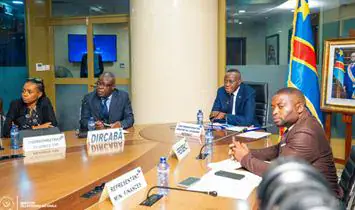
The International Monetary Fund (IMF) has commended the Democratic Republic of the Congo (DRC) for its progress in reforming the oil sector, specifically regarding subsidies for petroleum products and pricing structures. This was announced after a videoconference meeting between Deputy Prime Minister and Minister in charge of the National Economy Daniel Mukoko and an IMF delegation. The meeting was part of the fourth annual review of the DRC's economic and financial program supported by the IMF.
The videoconference meeting examined six main issues, including petroleum subsidies for the 2026 fiscal year, adjustment of the fiscal average border price, and exclusion of mining companies from the subsidy mechanism. The discussions also covered the impact of the war on the oil sector, assessment of storage capacity for essential products, and implementation of the Strategic Partnership Agreement. Mukoko presented economic data and reported gains accumulated in January and February 2026, followed by losses and shortfalls recorded from March of the same year.
According to Mukoko, the losses and shortfalls for the first and second quarters had been settled almost in their entirety. He also addressed the impact of the war on the supply of petroleum products, stating that government measures had helped prevent the risk of shortages in the country's various regions. Mukoko gave assurances regarding fuel availability while underscoring the need to strengthen supply mechanisms.
To strengthen supplies to the domestic market, particularly in inland areas, the government plans to establish a mechanism for the direct supply of petroleum products in collaboration with the Dangote refinery. This initiative aims to improve supplies through the Congolese Refining Industries Company (SOCIR). The meeting was attended by representatives of the Presidency of the Republic, the Prime Minister's Office, and various ministries and institutions.
IMF mission head Calixte Ahokpossi commended the progress made in reforming the pricing structure for petroleum products and congratulated Mukoko on the achievements in this area. The DRC's economic and financial program is supported by the IMF, and the fourth annual review aims to assess the country's economic performance and provide recommendations for future growth.
The DRC's oil sector has faced challenges in recent years, including the impact of the war on supply and distribution. The government's efforts to reform the sector and improve supply mechanisms have been praised by the IMF. The Strategic Partnership Agreement is expected to play a crucial role in strengthening the country's oil sector and improving economic performance.
The meeting between Mukoko and the IMF delegation highlights the DRC's commitment to economic reform and growth. The country's economic performance will continue to be monitored by the IMF, and further recommendations are expected to be made to support future growth and development.
Key points
- The IMF has commended the DRC for its progress in reforming the oil sector, particularly in subsidies and pricing structures.
- The DRC's government plans to establish a mechanism for the direct supply of petroleum products in collaboration with the Dangote refinery.
- The IMF's fourth annual review of the DRC's economic and financial program aims to assess the country's economic performance and provide recommendations for future growth.