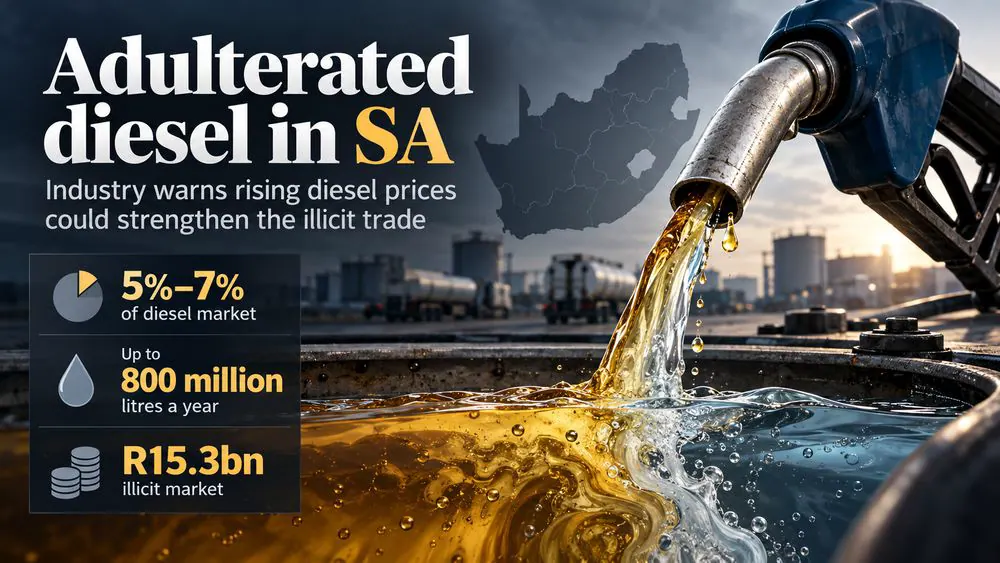
The Fuels Industry Association of South Africa (FIASA) has warned that diesel illegally blended with illuminating paraffin could account for as much as 7% of South Africa's diesel market, or up to 800 million litres a year. This translates to about 595 million to 800 million litres annually, with FIASA estimating the illicit market to be worth R15.3 billion and associated tax losses at between R3.6 billion and R4.2 billion a year.
The warning comes as diesel prices are expected to rise sharply this month, with the latest Central Energy Fund data indicating potential increases of about R2.73 a litre for 500ppm diesel and R3.13 for 50ppm. FIASA said higher legitimate diesel prices could strengthen the illicit trade by making heavily discounted fuel more attractive to customers. The different tax treatment of diesel and illuminating paraffin creates an estimated R6.03-a-litre gap that illegal operators could exploit.
Research indicates that illegal blenders can discount adulterated diesel by as much as approximately R3.02 per litre before reaching break-even point. FIASA cautioned that price alone did not prove adulteration, but said diesel consistently offered R2 to R3 a litre below comparable market prices without a credible explanation should raise concern. The industry association advised motorists and businesses to buy from reputable suppliers and be wary of sellers unable to provide verifiable licences, quality certificates, source documentation, and delivery records.
The problem of illicit diesel blending has already surfaced in government testing. In 2024, Department of Mineral Resources and Energy Deputy Director-General Tseliso Maqubela said 70 of 1 070 fuel samples taken from service stations across the country had failed compliance after the A1 marker used in illuminating paraffin was detected. This suggests that the issue is widespread and requires sustained enforcement involving SARS, police, and petroleum regulators.
The South African Revenue Service (SARS) has also taken steps to address the issue, detecting a national trend involving storage and distribution depots illegally mixing diesel with paraffin. In June 2025, SARS said it had identified 23 targets across Gauteng, Mpumalanga, and KwaZulu-Natal, and detained 953 515 litres of contaminated diesel, while six fuel depots were found to be in contravention of customs law. Assets and contaminated fuel valued at more than R367 million were also detained, and 13 criminal cases were registered with police.
The impact of illicit diesel blending on the economy and motorists is significant. Road Freight Association Chief Executive Gavin Kelly said dozens of hauliers among the association's members had reported contaminated-fuel incidents, sometimes discovering the problem only after serious mechanical failures. This can result in repair costs running into hundreds of thousands of rand per vehicle, alongside substantial downtime and potential contract penalties when deliveries are missed.
Experts warn that adulterated diesel can cause significant damage to vehicles, with WearCheck diagnostician Rivendren Wayne Moodley saying that paraffin reduces diesel's lubricity and can accelerate wear in high-pressure pumps and injectors. Mineral and Petroleum Resources Minister Gwede Mantashe recently described illegal diesel-paraffin blending as criminal activity that "undermines the rule of law, distorts markets, damages equipment, compromises consumer confidence, and poses significant risks to our economy and national security".
Key points
- Illicit diesel blending with illuminating paraffin could account for up to 7% of South Africa's diesel market.
- The illicit market is estimated to be worth R15.3 billion, with associated tax losses of between R3.6 billion and R4.2 billion a year.
- SARS has detained over 953 000 litres of contaminated diesel and R367 million in assets in its efforts to combat the issue.