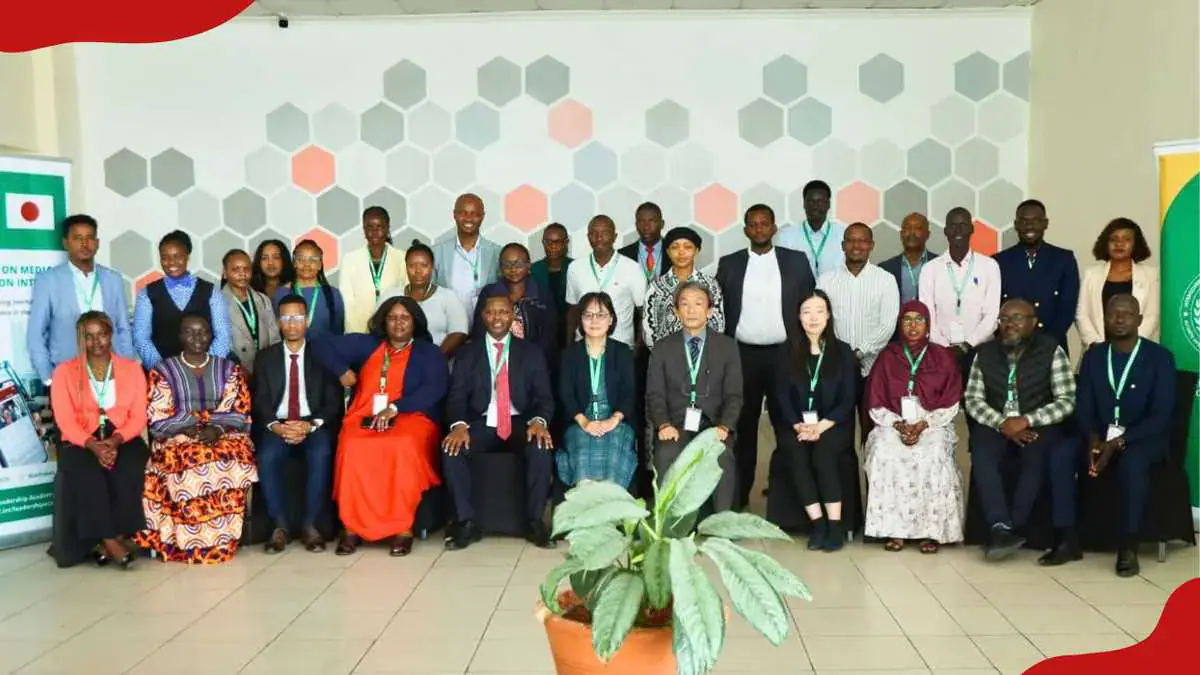
The IGAD Leadership Academy brought together journalists from Kenya, Somalia and South Sudan for a three-day training in Machakos from October 6 to 8, 2026. The training aimed to equip participants with skills to counter misinformation, narrative laundering and AI-powered disinformation ahead of upcoming general elections in all three countries. The programme was organised in response to the increasing threat of misinformation and coordinated influence campaigns during electoral periods.
Dr Simon Nyambura, the director of IGAD Centre of Excellence for Preventing and Countering Violent Extremism, urged participants to be proactive in producing stories that matter and actively debunk narratives that could escalate violence or deepen social divisions ahead of the polls. The workshop covered a wide range of topics, including public interest journalism, story framing and its effect on public perception, news verification, and the impact of Artificial Intelligence (AI) and emerging trends such as Foreign Information Manipulation (FIMI) and Narrative Laundering.
Renowned media and communications lecturer Dr Sam Kamau said the programme was built around the concerns of ordinary citizens, while also preparing journalists to handle the verification challenges posed by AI-driven disinformation. He stressed that trust remains one of the most pressing issues in the current information environment, where misinformation and conspiracy theories have eroded public confidence in the media. Dr Kamau warned that misinformation spikes reliably around elections and conflict.
Journalists received practical guidance on identifying and countering threats to information integrity. The training included a panel discussion moderated by Dr Kamau, featuring Citizen TV’s reporter and news anchor Melita Ole Tenges, Somali National News Agency (SNNA) editor Abdigan Abdullahi, The Radio Community (TRC) editor Daniel Garang and Communication specialist Sharon Kinyanjui. They concurred that news verification is central to the journalist’s work and must never be forfeited.
Participants shared their experiences and insights gained from the training. Abdigan emphasised the importance of accurate information as Somalia prepares to hold its first direct elections in decades, noting that access to reliable information is essential for an informed electorate. Mercy Washira, one of the participants, described the experience as a valuable encounter with seasoned practitioners, reinforcing the centrality of verification and the importance of remaining open to continuous learning as a media professional.
The Government of Japan supported the initiative, with Prof Hideaki Shinoda from Tokyo University of Foreign Studies praising the high level of engagement from participants throughout the course. He highlighted Japan's investment in capable individuals rather than large-scale infrastructure projects, describing it as a deliberate choice to contribute to their capacity building.
The training programme was a significant step towards enhancing the capacity of journalists from Kenya, Somalia and South Sudan to navigate the complex information landscape during electoral periods. Key outcomes included a deeper understanding of information integrity, practical skills in news verification, and a strengthened network of journalists committed to promoting accurate information.
Key points
- Journalists from Kenya, Somalia and South Sudan complete a three-day training programme focused on protecting information integrity during electoral periods.
- The training aimed to equip participants with skills to counter misinformation, narrative laundering and AI-powered disinformation ahead of upcoming general elections.
- The programme was organised by the IGAD Leadership Academy in response to the increasing threat of misinformation and coordinated influence campaigns during electoral periods.