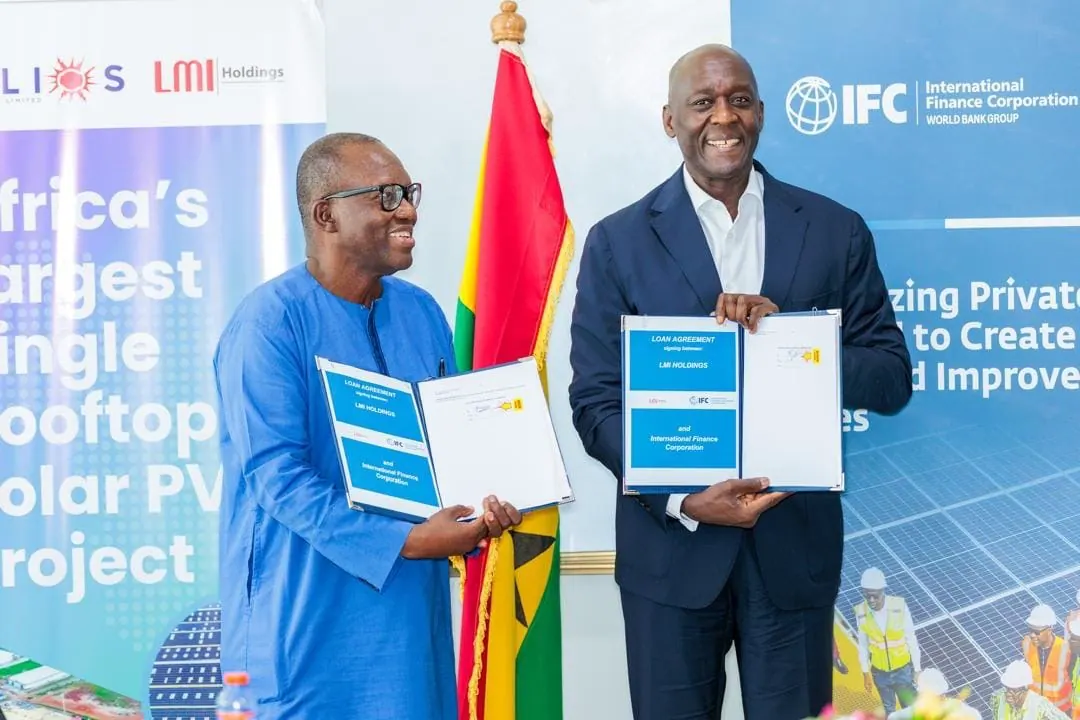
The International Finance Corporation (IFC) and LMI Holdings have signed a $39.5 million solar financing deal to support the growth of industries in Ghana's Tema and Dawa Industrial Zones. This project, part of the Solar for Industries (SFI) initiative, aims to provide a reliable and clean power supply to over 100 factories, warehouses, and processing plants. The deal marks an expansion of the IFC and LMI Holdings' renewable energy partnership, which seeks to address the industrial zones' power needs.
The solar project will finance the first 100-megawatt phase of a planned 200-megawatt solar photovoltaic facility in the Dawa Industrial Zone. Once operational, the facility is expected to provide businesses in manufacturing, agro-processing, logistics, and other industries with more reliable and affordable electricity. The project is anticipated to have a positive impact on the local economy, creating jobs and supporting Ghana's drive to expand manufacturing and boost local value addition.
During the construction phase, the project is projected to generate about 250 direct jobs and a further 500 indirect jobs. Once the solar facility becomes operational, it is expected to sustain 19 permanent jobs. This is significant, given Ghana's persistent youth unemployment concerns. The industrial zones already host a wide mix of manufacturing and logistics firms, and the new jobs will contribute to the broader economic footprint of these areas.
This latest commitment marks the second tranche of financing under the IFC-LMI Holdings partnership. The first phase of cooperation between the two included a $21 million tranche that IFC committed in its 2024 financial year and disbursed in the 2025 financial year, as part of a wider $100 million facility. The partnership between IFC and LMI Holdings is not new to Ghana's industrial landscape, with previous collaborations supporting the construction of a 16.82-megawatt rooftop solar installation at the Tema Industrial Zone.
The earlier partnership also financed an 11,000-cubic-metre-per-day water treatment plant serving the Dawa Industrial Zone. The new solar phase is expected to support Ghana's drive to expand manufacturing and boost local value addition by giving industrial customers access to reliable, affordable renewable power. The facility will also help businesses cut emissions across their production chains, improve efficiency, and expand operations.
The project aligns with Ghana's National Energy Transition Framework, a policy document that guides the country's shift toward greater renewable energy use while balancing energy security with development needs. Funding for the project combines IFC's own capital, support from the International Development Association's Private Sector Window, and additional private capital mobilised directly for the deal. This blended structure aims to increase the total capital available to complete the solar facility while keeping the cost of the power it generates affordable for industrial users.
Although a specific completion date for the 100-megawatt phase or timeline for the remaining 100 megawatts of the planned 200-megawatt project was not provided, the project is expected to have a significant impact on Ghana's industrial sector. Key points include:
Key points
- The project will provide reliable and clean power supply to over 100 businesses in Ghana's Tema and Dawa Industrial Zones.
- The project is expected to generate 250 direct jobs and 500 indirect jobs during the construction phase and sustain 19 permanent jobs once operational.
- The project aligns with Ghana's National Energy Transition Framework and will support the country's drive to expand manufacturing and boost local value addition.