Traditional leaders in Namibia frequently end up in the High Court to settle succession disputes, raising concerns about the credibility and relevance of traditional institutions. The latest dispute is over the leadership of the Masubia community, with the case set to return to court on October 1. This case highlights a bigger issue with the system, where succession disputes among traditional authorities often turn into protracted battles involving rival claimants, government investigations, and lawyers.
The Masubia dispute began after the death of Chief Kisco Maiba Liswani III in 2021, with competing claims emerging. The government investigated the claims, held public hearings, and consulted stakeholders before designating and formally recognising Mutwa as the new leader. However, the process is now being challenged in court. The judicial process should be allowed to run its course without prejudice, but Namibia should also confront the bigger problem of why these disputes keep arising.
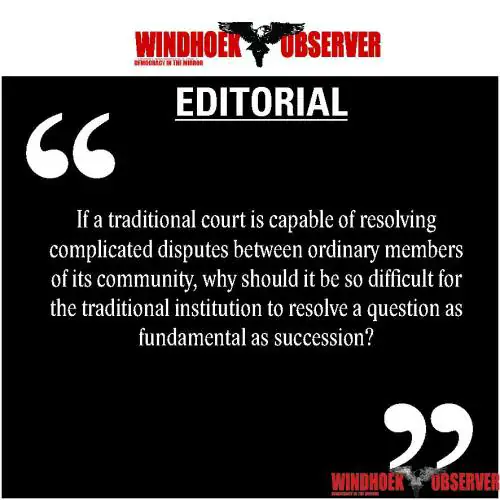
Traditional authorities are custodians of custom, tradition, community cohesion, and customary law, dealing with personal and consequential disputes. However, when disputes concern the traditional authority itself, they often escape the customary system and end up in the High Court. This contradiction raises questions about the ability of traditional institutions to resolve fundamental questions like succession.
Succession is the foundation of traditional leadership, yet the rules often become clear only after a leader dies. Competing interpretations emerge, genealogy is scrutinised, and seniority is contested, involving government, lawyers, and courts. The Masubia case illustrates this difficulty, with the courts set to determine whether the challenge to Mutwa's recognition has merit.
The government needs to show leadership by initiating a national conversation with recognised traditional authorities to create a system with clear rules, reducing room for suspicion. This conversation should focus on documenting succession rules, including who qualifies, who determines lineage, and what role the royal family, elders, and community play.
Traditional authorities should establish mechanisms for mediation and customary appeal in contested successions, with the High Court as the ultimate guardian of legality. However, traditional institutions must build credible mechanisms for resolving disputes themselves, as there is something fundamentally wrong when they cannot resolve leadership disputes peacefully.
The consequences of continued succession battles are far-reaching, risking weaker public confidence in traditional leadership, divided communities, and cultural institutions becoming political battlegrounds. If this continues, younger generations may question the authority of traditional institutions. Namibia needs stronger traditional authorities, not fewer, to maintain their relevance and credibility.
Key points
- The government should initiate a national conversation with traditional authorities to document succession rules and establish mechanisms for mediation and appeal.
- Traditional institutions must build credible mechanisms for resolving disputes themselves to maintain public confidence.
- The High Court should remain the ultimate guardian of legality in traditional leadership disputes.