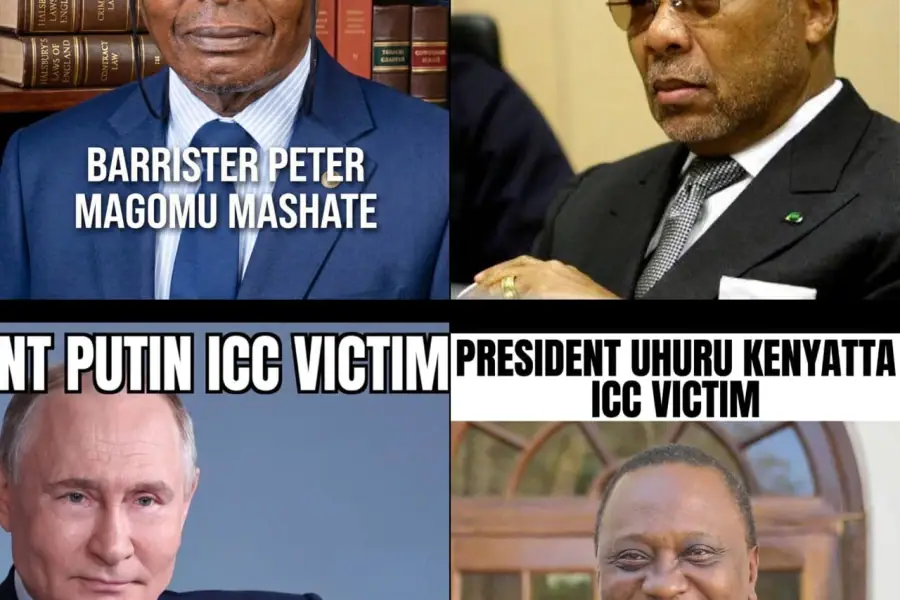
The International Criminal Court (ICC) is fighting for its survival twenty years after the Rome Statute entered into force, promising to end impunity for the gravest crimes known to humanity. The court's structural flaws have led to criticism of selective justice, particularly in Africa. The African Union and other critics argue that the ICC's focus on African nations for its first twenty years has created a perception of bias. The ICC's architecture invites this criticism, with permanent members of the UN Security Council, including the US, Russia, and China, refusing to ratify the treaty.
The ICC's selective justice has resulted in the indictment of six prominent African leaders: Sudan's Omar al-Bashir, Libya's Muammar Gaddafi, Côte d'Ivoire's Laurent Gbagbo, Kenya's Uhuru Kenyatta and William Ruto, and the Democratic Republic of the Congo's Jean-Pierre Bemba. However, none of these leaders were convicted, with Gbagbo and Bemba acquitted after years of detention, and the cases against Kenyatta and Ruto collapsing due to insufficient evidence. The ICC's failure to secure convictions has damaged its credibility, particularly in Africa.
The ICC's actions have also sparked a sovereign backlash, with Sahelian nations, including Mali, Burkina Faso, and Niger, along with Chad, moving to sever ties with the court, citing neo-colonial bias. The ICC's recent attempts to issue warrants for Russian President Vladimir Putin, Israeli Prime Minister Benjamin Netanyahu, and former Philippine President Rodrigo Duterte have triggered a deeper geopolitical crisis. The US has imposed sweeping sanctions on ICC officials, while Moscow has issued counter-warrants.
The ICC's enforcement paralysis has been exposed by these warrants, with European signatories hesitating or refusing to execute warrants against leaders like Netanyahu. This double standard has become undeniable, with the ICC relying entirely on state cooperation and lacking a police force. A tribunal whose warrants are ignored by its loudest Western backers is in mortal peril.
To survive, the ICC requires radical reform and a return to its foundational principle of complementarity. The Rome Statute designed the ICC as a court of last resort, intervening only when national courts are genuinely unwilling or unable to prosecute. However, the ICC has acted as a court of first instance, importing complex, distant conflicts into Europe at astronomical cost.
Over 120 states, including 33 African nations, remain party to the Statute, proving the appetite for accountability endures. However, survival requires divorcing the court from Security Council geopolitics, overhauling investigative rigor, and empowering regional mechanisms like the African Court on Human and Peoples' Rights. Until justice applies equally from Washington and Tel Aviv to Moscow and Kampala, the ICC will remain an arena of power politics rather than universal law.
Barrister Peter Magomu Mashate argues that the ICC's future depends on its ability to reform and return to its foundational principles. The writer, an administrative, constitutional, and human rights barrister-at-law, emphasizes that the ICC must prioritize accountability and justice for all, rather than being influenced by powerful nations. The ICC's credibility and survival depend on its ability to address these challenges and ensure that justice is applied equally and universally.
Key points
- The ICC's selective justice and sovereign backlash threaten its global credibility and survival.
- Radical reform and a return to the court's foundational principle of complementarity are necessary for the ICC's survival.
- The ICC must prioritize accountability and justice for all, rather than being influenced by powerful nations.
Reporting sources
- Sword for the Weak or Shield for the... · nilechronicles.com