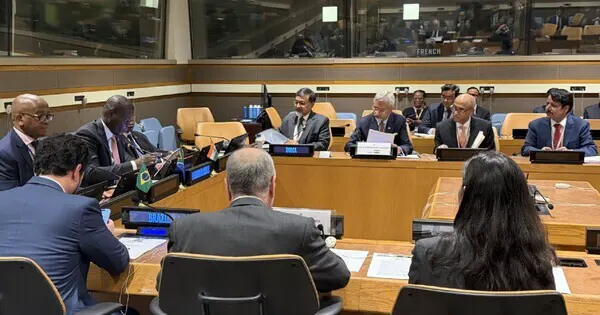
India, Brazil, and South Africa have called for the immediate commencement of formal, text-based negotiations to overhaul the UN Security Council within a fixed timeframe. The decisions were made during the 14th IBSA Trilateral Ministerial Commission, held on the sidelines of the 81st Session of the UN General Assembly in New York. The meeting was attended by South Africa's Minister of International Relations and Cooperation Ronald Lamola, External Affairs Minister S Jaishankar, and Brazil's Minister of Foreign Affairs Mauro Vieira.
The IBSA Foreign Ministers expressed deep concern over the persistent paralysis within the Inter-Governmental Negotiations on UN Security Council reform. They urged a result-oriented process to adapt the body to contemporary geopolitical realities. The Ministers also reaffirmed their commitment to a representative global order, supporting the legitimate aspirations of African countries to secure a permanent presence in the UNSC.
The IBSA grouping formally backed India's proposal for a Critical Minerals Circularity Initiative under the G20. The initiative aims to drive key technological innovations, including recycling, urban mining, and second-life batteries. The Ministers noted that producer countries in the developing world continue to face severe challenges, including under-investment and limited local processing.
On counter-terrorism, the Ministers strongly condemned the terrorist attack in Pahalgam, Jammu and Kashmir, India, in April 2025. They reaffirmed zero tolerance and rejecting double standards, calling for concerted action against all UN-listed terrorist entities and proxy groups. The joint statement also urged the expeditious adoption of the Comprehensive Convention on International Terrorism at the UN.
The Ministers expressed serious concern over the imposition of unilateral tariffs, protectionist measures, and unlawful coercive economic actions that bypass international law. They called for comprehensive reforms of the World Trade Organisation and Bretton Woods institutions, including the International Monetary Fund and World Bank, to enhance the voice and representation of Emerging Markets and Developing Countries.
The IBSA Foreign Ministers voiced grave concern over escalating tensions in the Middle East, highlighting the spillover effects on energy and food security in the Global South. They reaffirmed support for a two-state solution to the Israeli-Palestinian conflict, calling for an unhindered humanitarian flow into Gaza and full respect for UNRWA's mandate.
The discussions come at a time when developing economies are dealing with the economic consequences of conflicts, including disruptions to energy and food supplies, inflationary pressures, and constraints on public finances. The IBSA Foreign Ministers' Meeting provided an opportunity for India, Brazil, and South Africa to coordinate positions on reforms to global institutions and address shared concerns of developing countries at the UNGA.
Key points
- IBSA FMs call for urgent, text-based UNSC reforms to adapt to contemporary geopolitical realities.
- The Ministers endorse India's Critical Minerals Circularity Initiative to drive key technological innovations.
- They strongly condemn the terrorist attack in Pahalgam, Jammu and Kashmir, India, in April 2025.