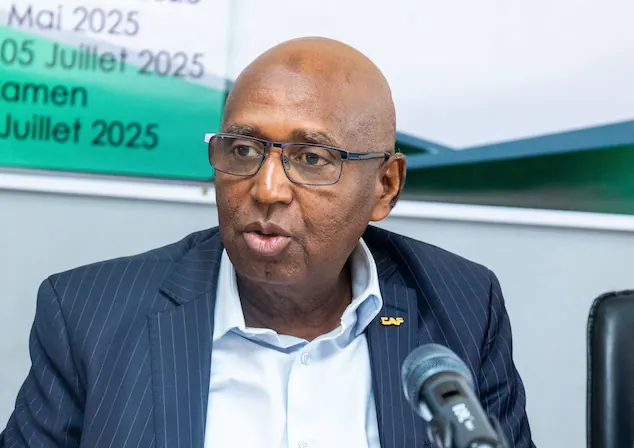
The Guinean national team, Syli National, is set to receive their service passports, a long-standing demand championed by the Feguifoot. This development is a result of efforts initiated by Ibrahima Blasco Barry, Secretary General of the Fédération Guinéenne de Football (Feguifoot), in July 2026. He had requested the Ministry of Youth and Sports to intervene with the authorities to grant these travel documents to the entire sports delegation. The initial request covered 53 beneficiaries, including 30 players, 17 technical and administrative staff, 3 members of the Feguifoot Executive Committee, and 3 representatives of the National Directorate of Physical Activities, Sports, and Leisure.
The attribution of service passports aims to free the selection from recurring visa constraints and potential delays during the qualifying campaign. Following the victory against Kenya (1-0) in the second day of matches, the measure was formalized by a decision of President Mamadi Doumbouya, enabling the Ministry of Sports to start the enrollment process. This move is expected to ease travel logistics for the team during the qualifying matches. The Feguifoot's efforts to secure these documents demonstrate its commitment to supporting the national team.
Ibrahima Blasco Barry's role extends beyond passport facilitation. In September, he played a crucial part in resolving a logistical crisis in Johannesburg. After a 2-1 defeat to South Africa, the Guinean delegation was stranded due to issues with flight authorization and landing permits. Barry's direct intervention with the Confederation of African Football (CAF), coupled with the support of the Guinean Embassy in South Africa, helped resolve the situation, and the team returned to Conakry on September 28.
The Feguifoot, under Barry's leadership, has also been involved in monitoring medical files and youth selections. In the case of Oumar Konaté, a player in the Syli U17 team, the CAF had contested his eligibility based on MRI tests. Barry requested a re-examination of the medical file, which led to the CAF conducting new tests and ultimately reinstating the player. This decision allowed the Syli U17 to qualify for the 2027 CAN, marking their first qualification in seven years.
In addition to these accomplishments, the U20 national team is currently preparing for the UFOA-A tournament, a qualifier for the CAN U20. The team is training at the Khoria Sports Center in Dubréka, ahead of the tournament scheduled for October 15-30, 2026, in Bamako, Mali. The Guinean team will face Mali, Liberia, and Gambia in the competition. These developments demonstrate the Feguifoot's commitment to supporting the country's football teams.
Ibrahima Blasco Barry's contributions to Guinean football have been characterized as "discreet" but impactful. As the Secretary General of the Feguifoot, he has been working behind the scenes to address various challenges facing the national teams. His efforts have helped to resolve logistical issues, secure essential documents, and ensure the team's eligibility to compete in international tournaments.
The Feguifoot's efforts, led by Barry, reflect the organization's dedication to promoting and developing football in Guinea. The progress made by the national teams, both on and off the field, is a testament to the hard work and commitment of the Feguifoot and its Secretary General. As the Guinean football scene continues to evolve, the role of Ibrahima Blasco Barry and the Feguifoot will likely remain crucial in shaping the country's football future.
Key points
- Ibrahima Blasco Barry played a crucial role in securing service passports for the Syli National team.
- Barry's intervention helped resolve a logistical crisis in Johannesburg, allowing the team to return to Conakry.
- The Feguifoot, under Barry's leadership, successfully contested the CAF's decision regarding Oumar Konaté's eligibility, allowing him to play for the Syli U17 team.