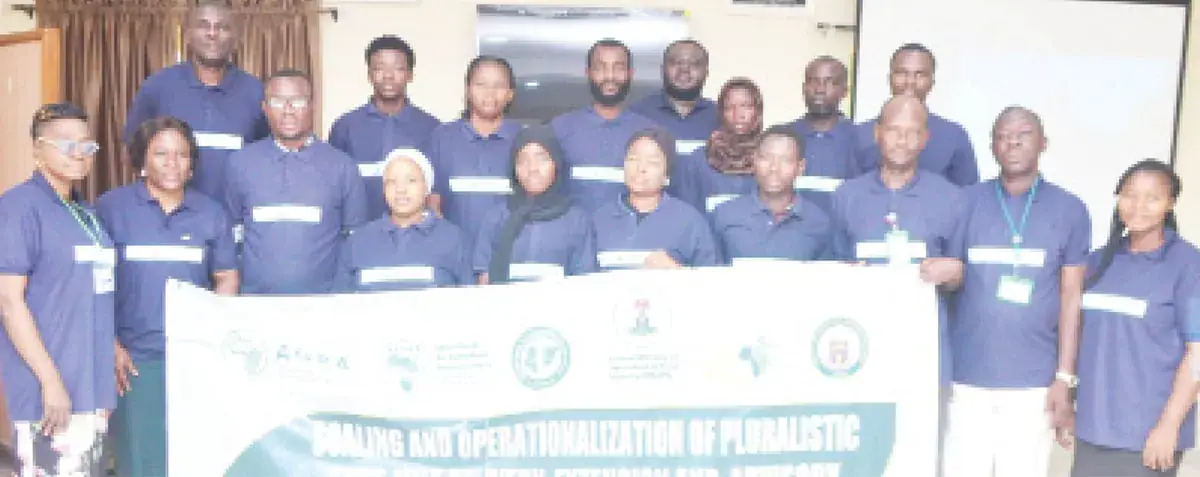
The Institute of Agricultural Research and Training (IAR&T), Ibadan, in collaboration with the Sasakawa Africa Association (SAA), recently organized a workshop to train youth agro-dealers across the Southwest region of Nigeria. The training, which took place at the IAR&T premises, aimed to strengthen the capacity of participants for effective agricultural information dissemination and advisory services to farmers. The workshop's theme was "Scaling and Operationalisation of Pluralistic Last Mile Delivery, Extension and Advisory Services in Africa".
The Head of IAR&T's Digital Agriculture, Farming Systems and Extension Programme (DAFS&EP), Prof. Ajoke Oyegbami, welcomed participants and encouraged them to take the training seriously. She noted that the workshop was designed to equip them with the necessary knowledge and skills for effective information dissemination while building their confidence in carrying out their responsibilities. The Representative of the Country Director of SAA, Dr. Anjola Fadairo, appreciated the Institute Management for the collaboration and highlighted SAA's objective and mission.
Dr. Anjola Fadairo emphasized the importance of digital agriculture in strengthening farmers' capacities, building their confidence, improving their livelihoods, and developing effective customer relationships. She charged participants to make good use of the opportunity. The Executive Director of IAR&T, Prof. Gabriel Oluwatosin, congratulated participants on the opportunity to benefit from the workshop and welcomed them to the Institute. He urged them to pay close attention to the training sessions and make the most of the knowledge and experience to be shared.
The workshop featured technical sessions with presentations on digital marketing and extension, quality assurance and safety practices in agro-input distribution, customer relations, and record keeping. Experts from IAR&T delivered the presentations, aiming to equip participants with the required knowledge and skills on effective extension service delivery in Africa. Upon completion, participants were presented with starter-packs to aid the practical application of the knowledge acquired.
The training is part of IAR&T's efforts to strengthen agricultural extension and promote food security in the Southwest zone. The Institute, in collaboration with other agencies, has linked farmers with financial institutions, agro-input dealers, and other stakeholders to enhance their production. A market hub was organized to link farmers, extension agents, agro-input dealers, and financial institutions, with participants from the Southwestern states of Nigeria in attendance.
At the market hub, the Director of IAR&T, Prof. Gabriel Oluwatosin, represented by Prof. Johnson Adetumbi, urged farmers not to focus solely on what money can buy but to ensure they acquire knowledge and exchange contacts with stakeholders to boost their production. The Representative of SASAKAWA, Dr. Mrs. Anjolaoluwa Fadairo, appreciated the management of IAR&T for the partnership and highlighted the program's objective of educating key players and extension agents on reaching out to core farmers in villages.
The program, sponsored by SASAKAWA and other notable organizations in agriculture, was attended by stakeholders from the Southwestern states of Nigeria. The initiative aims to promote pluralistic extension services, as Nigeria no longer depends solely on public extension agents. Agro-dealers are being recruited to assist extension agents in disseminating technologies to farmers due to their closeness and regular contact with them.
Key points
- The training aims to enhance agricultural extension services and promote food security in Southwest Nigeria.
- The program promotes pluralistic extension services, involving agro-dealers in disseminating technologies to farmers.
- The initiative links farmers with financial institutions, agro-input dealers, and other stakeholders to enhance their production.
Reporting sources
- IAR&T, Sasakawa Africa Association train youth agro-dealers · Nigerian Tribune