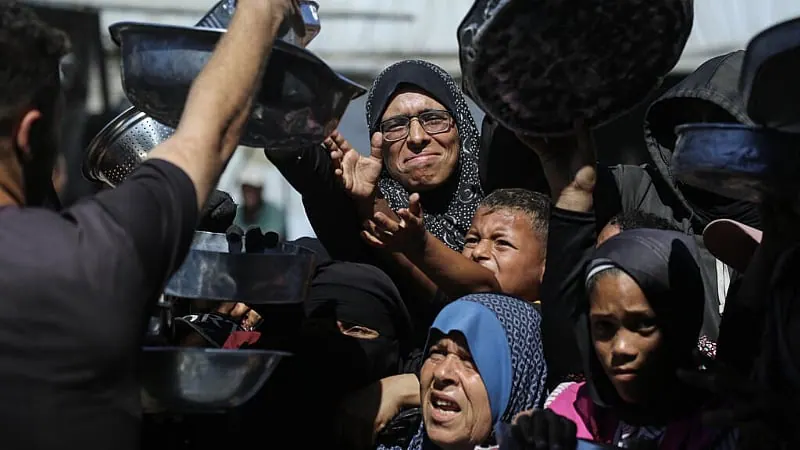
A year after a ceasefire aimed to alleviate the humanitarian crisis in Gaza, the situation remains dire. Nihaya Al-Masri, a 35-year-old mother of eight, exemplifies the struggles faced by many Gazans. She relies on a community kitchen to feed her family of 10, who survive on one meal a day. Her husband, wounded in both legs, cannot hunt for food, leaving Masri to collect meager rations of rice, lentils, and chicken.
The humanitarian situation in Gaza was declared a state of famine in August 2025 by the Integrated Food Security Phase Classification (IPC), a United Nations-backed body. However, Israel disputed this claim, and by December, the UN had lifted the declaration, citing improved conditions due to increased supplies during the ceasefire. COGAT, the Israeli defense ministry organization responsible for civilian affairs in Palestinian territories, asserts that the humanitarian situation is stable.
Despite some food entering Gaza, the lack of nutritional variety poses a significant health threat. Shaun Hughes of the UN's World Food Programme notes that 1.4 million out of 2.1 million people are acutely food insecure, with 200,000 on the brink of famine. Hughes emphasizes that dietary diversity is crucial, particularly for children, pregnant women, and breastfeeding mothers, who require micronutrients from protein-rich foods, fruits, and vegetables.
Malnutrition in Gaza is not only caused by food scarcity but also by the lack of essential nutrients. Masri's children dream of eating fruit, but their family cannot afford it. Her son suffered from malnutrition during the 2025 famine, but his condition is slowly improving. Malnutrition weakens children's immune systems, making them vulnerable to illnesses and stunting their growth.
The effects of malnutrition in Gaza are long-lasting and far-reaching. Hughes warns that repeated episodes of acute malnutrition can lead to cognitive and physical impairments that persist into later life. At Khan Yunis's Nasser hospital, head of the malnutrition unit Israa al-Najjar has observed an increase in syndromes and conditions linked to malnutrition that affect the immune system.
A recent study by Medecins du Monde found that 93 percent of pregnant or breastfeeding women in Gaza have symptoms of anemia, closely linked to malnutrition. Only 17 percent of these women have a sufficiently varied diet to meet their nutritional needs. The situation is further complicated by the fact that many Gazans, like Masri, rely on community kitchens and struggle to access basic necessities.
As the situation in Gaza continues to deteriorate, residents like Masri face a daily struggle to survive. Despite her asthma and exhaustion, Masri continues to visit the community kitchen, while her children try to reinforce their tent with scavenged materials. She describes it as "shameful" that her children have to live in such conditions, emphasizing that this is not a normal way of life.
Key points
- 1.4 million people in Gaza are acutely food insecure, with 200,000 on the brink of famine.
- Malnutrition in Gaza is caused by both food scarcity and lack of essential nutrients.
- Repeated episodes of acute malnutrition can lead to long-lasting cognitive and physical impairments.