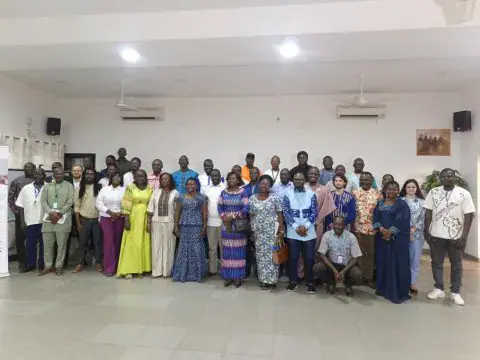
The 2025 report on the achievements of international humanitarian organizations in the AES space was officially presented on November 24, 2026. This regional document is a collaboration between the Forum of International Humanitarian NGOs in Burkina Faso (FONGIH), its counterpart in Mali (FONGIM), and the coordination of international NGOs represented in Niger (OIREN). A total of 184 international NGOs participated in the data collection for this report.
These organizations have mobilized around 275 billion FCFA to finance interventions in various domains, including water, hygiene, and sanitation, shelters, education, health, nutrition, food security, and protection. Their actions have benefited 8,645,985 people in the three countries. The director of FONGIH, Yves Sosthène Habumugisha, stated that the publication of this report aims to inform the public, promote accountability and transparency, and highlight the contribution of international NGOs to the efforts of the governments of the three countries.
In Burkina Faso, 34 member organizations of FONGIH participated in the data collection and mobilized around 44 billion FCFA to assist over 2.29 million people. Their interventions also contributed to the national economy, with an estimated tax contribution of 7.6 billion FCFA. Notably, 95% of the staff mobilized by these organizations are nationals. The organizations implemented various projects, including the construction of 71 boreholes, distribution of 4,904 handwashing devices, and creation of 168 management committees in the water, hygiene, and sanitation sector.
In the education sector, over 3 billion FCFA were mobilized to support 675 schools, establish 4,904 bridge classes, train 5,489 teachers, and create 33 learning spaces. Additionally, 4,184 young people received vocational training. In the health and nutrition sector, 12 billion FCFA were mobilized to support 615 health centers with vaccines and 396 with equipment, screen 756,717 children for malnutrition, and provide care to 285,045 children.
The organizations also implemented projects in the food security sector, assisting 252,611 people with food, training 30,000 people in agriculture, distributing 63,000 tons of food, and establishing 120 hectares of market gardens. Furthermore, 103,978 people benefited from specialized psychological support, 7,008 survivors of gender-based violence received care, and 5,535 community leaders were trained in the protection sector.
Despite the progress made, the organizations faced challenges, including access to populations, significant funding shortages, administrative hurdles, and recurring climate shocks. To address these challenges, the organizations plan to strengthen their collaboration to improve data collection, document their contribution to national priorities, and advocate for more funding for the Sahel region.
The report was produced with the support of the NGO Care within the framework of the PAMIB project. The organizations aim to promote a better understanding of their interventions and contributions to the development of the AES space. A digital dashboard, regularly updated, will allow the public to consult the intervention areas of the organizations and appreciate their efforts in response to population needs.
Key points
- Humanitarian organizations in the AES space mobilized approximately 275 billion FCFA in 2025.
- The organizations provided assistance to over 8 million people in Burkina Faso, Mali, and Niger.
- The report aims to promote accountability, transparency, and visibility of humanitarian interventions in the AES space.