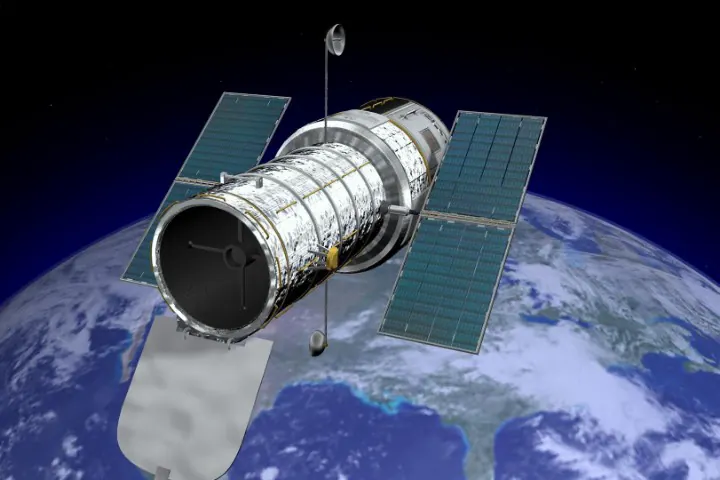
The Hubble Space Telescope, launched by NASA in April 1990, has achieved a remarkable milestone by completing its 200,000th orbit around Earth. This accomplishment surpasses the telescope's designed lifespan of 15 years, demonstrating its continued productivity in scientific research. According to NASA, Hubble has traveled over 5 billion miles (8 billion kilometers) around Earth and conducted over 1.7 million observations of the universe.
Hubble was launched on April 24, 1990, aboard the Space Shuttle Discovery and has been operational for over 36 years. The telescope orbits Earth at an altitude of approximately 300 miles (483 kilometers), moving at a speed of about 17,000 miles per hour (27,000 kilometers per hour). This allows it to complete around 15 orbits per day, or one orbit every 95 minutes. Its longevity and continued scientific output are a testament to its robust design and the dedication of NASA's engineers and scientists.
Recently, Hubble has been involved in several significant scientific endeavors, including measuring the expansion of the universe. This research is a crucial aspect of understanding the cosmos and has far-reaching implications for our knowledge of the universe. The telescope's ability to adapt to new challenges has been demonstrated by its successful operation with only one gyroscope in 2024.
Despite its impressive performance, Hubble is no longer a readily repairable telescope. The last space shuttle servicing mission was conducted in 2009, and there are currently no planned maintenance missions. NASA expects Hubble to remain productive until the next decade, although its orbit will gradually decay due to atmospheric drag.
As Hubble continues to operate, NASA is planning for its eventual decommissioning. The agency aims to dispose of the telescope in a controlled manner, likely through a targeted re-entry into Earth's atmosphere. This process is not expected to occur until the mid-2030s at the earliest.
Throughout its operational life, Hubble has undergone numerous upgrades and modifications, including the installation of new instruments and the implementation of innovative technologies. These efforts have enabled the telescope to remain a cutting-edge observatory, making groundbreaking discoveries and capturing stunning images of the universe.
The successful operation of Hubble has paved the way for future space-based observatories, such as the James Webb Space Telescope. As NASA continues to push the boundaries of space exploration and scientific research, the legacy of Hubble will endure as a testament to human ingenuity and the boundless curiosity of the scientific community.
Key points
- NASA's Hubble Space Telescope has completed 200,000 orbits around Earth, far exceeding its designed lifespan of 15 years.