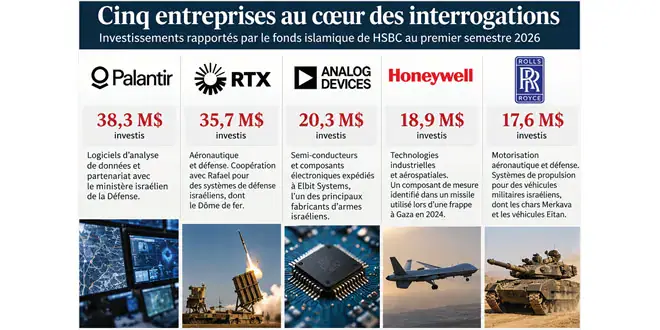
A recent investigation has revealed that HSBC's Islamic Global Equity Index Fund, which claims to adhere to Islamic finance principles, has invested heavily in companies connected to Israel's military industry. The fund, which manages over $8 billion in assets, has invested approximately $130.8 million in five companies: Palantir Technologies, RTX, Analog Devices, Honeywell International, and Rolls-Royce Holdings. These investments have raised concerns about the fund's compliance with Islamic finance principles and its responsibility to investors.
The five companies in question have varying degrees of involvement with Israel's military industry. Palantir Technologies, a US-based data analysis company, has partnered with the Israeli Ministry of Defense to support "war-related missions." RTX, a US defense group, collaborates with Rafael Advanced Defense Systems, an Israeli state-owned company, to produce missile components and interceptors. Analog Devices, a US semiconductor company, has supplied components to Elbit Systems, a major Israeli private arms manufacturer.
Honeywell International, a US-based conglomerate, has been linked to the production of missile components used in attacks on Gaza. In June 2024, an investigation found that a Honeywell-made component was used in a missile that killed nearly 40 Palestinians, including children and women, in a UN-administered school in Gaza. Rolls-Royce Holdings, a UK-based aerospace company, has provided propulsion systems for Israeli military vehicles, including Merkava tanks and Eitan armored vehicles.
The investments have sparked questions about the fund's adherence to Islamic finance principles, which prohibit investments in companies involved in activities considered haram, or forbidden. The fund's independent committee, composed of two Islamic jurisprudence specialists, is responsible for ensuring compliance with these principles. However, experts argue that the committee's criteria may not be uniform, and the fund's investments may contradict its stated ethical approach.
Specialists in Islamic finance have highlighted the lack of transparency and governance in the fund's investment decisions. Wahyu Jatmiko, a specialist at Southampton Business School, notes that there is a "tension apparent between the restrictions announced by the bank and the investments reported." Muhammed Ebrahim, a professor of finance at Durham University Business School, points out that the fund's procedures may not adequately assess the end-use of products or the identity of their users.
The investigation has also raised concerns about the broader implications for Islamic finance and its reputation. The fund's investments in companies linked to Israel's military industry have been criticized by some as contradictory to the principles of Islamic finance. The incident has sparked calls for greater transparency and accountability in Islamic finance, particularly in the certification and selection criteria for Shariah-compliant investments.
In response to the allegations, HSBC has faced criticism for its investment decisions and its responsibility to investors. The bank's reputation and credibility in the Islamic finance sector have been questioned, and the incident has sparked a wider debate about the need for greater transparency and accountability in Islamic finance.
Key points
- The fund's investments in companies linked to Israel's military industry have raised concerns about its compliance with Islamic finance principles.
- The incident has sparked calls for greater transparency and accountability in Islamic finance.
- The fund's reputation and credibility in the Islamic finance sector have been questioned.