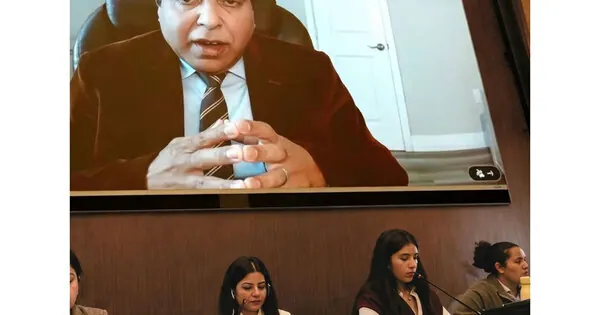
Human Rights Focus Pakistan (HRFP) President Naveed Walter addressed the 63rd Session of the United Nations Human Rights Council in Geneva, highlighting concerns over child and forced marriages in Pakistan. He emphasized the need for stronger implementation and enforcement of child-marriage laws. According to HRFP, Pakistan has made significant legislative changes, including establishing 18 as the minimum marriage age for both girls and boys.
Walter pointed out that despite these legislative advancements, challenges persist. Religious parties have challenged the laws, arguing they contradict the Holy Quran and Sunnah. He stressed that the effectiveness of these laws depends on consistent enforcement and protection by courts and public institutions. The real test lies in whether these laws will be upheld and protect every child.
The HRFP President expressed concern over the continuing legal uncertainty surrounding marriages involving girls under 18. He highlighted cases where statutory child-marriage protections conflict with interpretations of personal or religious law. Judicial approaches have diverged, particularly in determining a girl's age, with official age documentation and NADRA records playing a significant role.
Walter also discussed instances where judges have defined puberty with reference to Sharia principles and classical Islamic legal thought. He emphasized that undocumented cases cannot be prosecuted. Furthermore, he raised concerns about allegations of abduction, forced conversion, and child marriage involving girls from religious-minority communities.
UNICEF reports that Pakistan has one of the world's largest populations of child brides, with millions of women married before reaching 18. Walter argued that media-reported cases and court proceedings do not represent the actual scale of the problem. He emphasized that existing laws were often ignored, and the challenge now lies in enforcement.
To address these issues, Walter called for stronger implementation and enforcement of Pakistan's child-marriage laws. He urged authorities to introduce mandatory age verification through CNIC, B-Form, and NADRA records before marriage registration. Additionally, he recommended publishing nationwide enforcement data annually and harmonizing relevant personal and family laws to ensure effective legal remedies and protection for children subjected to coerced marriages.
Walter concluded by reaffirming HRFP's commitment to documenting violations and advocating for the effective protection of children and vulnerable communities. He called on the international community to raise these issues during Pakistan's human-rights review processes and to hold Pakistan accountable for resolving the conflict between 'puberty' and 'eighteen' in its courts. HRFP further advocated for stronger monitoring of child-marriage enforcement through international human-rights and trade-related review mechanisms.
Key points
- HRFP President Naveed Walter raises concerns over child and forced marriages in Pakistan at the UN Human Rights Council.
- Pakistan has made significant legislative changes to address child marriage, but challenges persist in enforcement.
- The international community is urged to hold Pakistan accountable for resolving the conflict between 'puberty' and 'eighteen' in its courts.