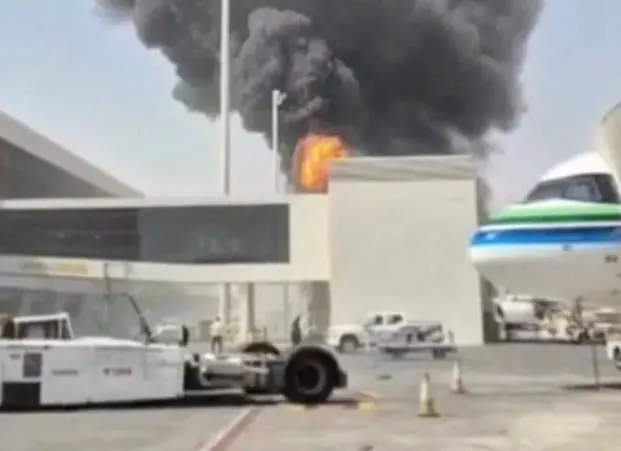
On Saturday, 10 October 2026, Riyadh's King Khalid International Airport was attacked for the third time in a week, resulting in one of the deadliest attacks on Saudi Arabia in over a decade. According to Saudi authorities, at least 12 people were killed and more than 300 wounded in the attack. The victims came from various countries, including four Saudis, two Bangladeshis, and one each from the US, Jordan, Palestine, Syria, Sudan, and Egypt.
The attack on King Khalid International Airport followed two earlier strikes that week on the same airport and Abha International Airport. On Tuesday and Wednesday, three people were killed and 36 wounded in attacks on King Khalid and Abha International Airport. Another attack on Thursday killed three Saudis, including a pilot, and heavily damaged a Saudi commercial plane parked on the tarmac.
A Houthi military spokesman described the attack as "airport-for-airport," a response to Saudi attacks on Sanaa International Airport and the airport in Hodeidah, with the aim of imposing a blockade on all Saudi airports. The Houthis launched this campaign this summer and have warned of a long conflict. The Washington Post reports that it is unfolding amid a wider Iran war, with the Houthis also striking Saudi oil infrastructure.
Saudi Arabia is no stranger to Houthi fire, with Abha airport being attacked in 2019, 2020, and 2021, and again by drones on 13 July 2026. However, what has changed is the scale and target of the attacks: a major international airport in the capital, with mass casualties, repeated within days. The Saudi-led coalition called the attack a "full-fledged war crime" and promised a decisive response.
The international community has condemned the attack, with the UN envoy for Yemen calling it "a grave escalation." President Trump denounced the attack as "terrible" and said the US is evaluating whether to join Saudi Arabia's offensive on the Houthis. Pakistan, India, and Canada also condemned the attack. The risks of further retaliation are clear, with potential consequences including widening the war, hitting oil infrastructure and global energy prices, disrupting air travel, and endangering the millions of foreign workers and pilgrims in the kingdom.
The attack has significant implications for Africa and West Africa, particularly for import-dependent West African economies that could see fuel prices rise. The instability in the Gulf could also threaten Red Sea shipping routes that carry African trade and put at risk the many Nigerians, Ghanaians, and other Africans who work in or travel to Saudi Arabia. Two of the dead were from Sudan and Egypt, highlighting the international nature of the conflict.
The attack on Riyadh airport has resulted in all flights being diverted from the airport, which serves a city of 8 million people. Western governments have advised citizens to avoid the area. The incident has raised concerns about the security of air travel and the potential for further attacks on Saudi Arabia's airports and infrastructure.
Key points
- The attack on Riyadh airport is the deadliest on Saudi Arabia in over a decade, with at least 12 people killed and over 300 wounded.
- The Houthis have launched a campaign of attacks on Saudi airports, with the aim of imposing a blockade on all Saudi airports.
- The international community has condemned the attack, with the UN envoy for Yemen calling it "a grave escalation" and President Trump denouncing it as "terrible".