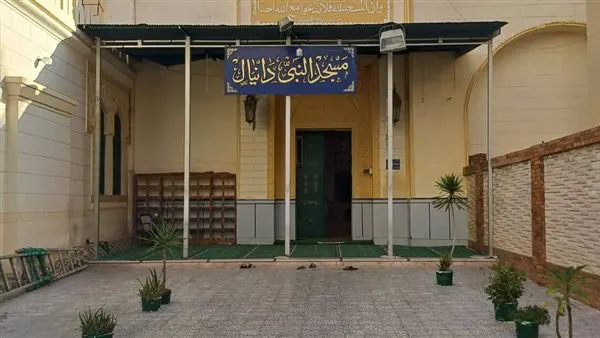
Located in Alexandria, Egypt, the Nabi Daniel Mosque is an ancient site that has been a center of learning and worship for centuries. The mosque is named after Sheikh Muhammad Daniel Al-Mawsili, a prominent scholar of the Shafi'i school of thought, who arrived in Alexandria in the late 8th century and made it his home until his death in 810 AH. He was buried on the site, which eventually became a popular pilgrimage site.
The mosque's history is intertwined with various narratives, including one that attributes the tomb beneath the mosque to the Prophet Daniel, said to have been discovered during the conquest of Alexandria. According to this account, Caliph Umar ibn Al-Khattab asked Ali ibn Abi Talib about the owner of the tomb, and was told it belonged to Prophet Daniel. However, some archaeologists question the accuracy of this story, suggesting that the tomb actually belongs to Sheikh Muhammad Daniel Al-Mawsili.
The mosque's architecture reflects a blend of styles, with a rectangular layout, a central courtyard, and a main entrance on the southwestern side. The prayer hall is divided into eight sections, supported by seven marble columns, and features a mihrab niche. The mosque also houses a shrine, located beneath the prayer hall, which can be accessed by descending about five meters. The shrine contains two wooden structures, one attributed to Sheikh Muhammad Daniel Al-Mawsili or Prophet Daniel, and the other known as the tomb of Luqman al-Hakim.
The mosque has undergone several renovations and expansions throughout its history. According to Ali Pasha Mubarak's book "Al-Khitlat Al-Tawfikiyah", the mosque was initially a small structure that was renovated during the reign of Muhammad Ali Pasha in 1238 AH. However, historian Hassan Abdel Wahab disputes this account, arguing that the mosque's architectural style dates back to the 12th century AH.
Today, the Nabi Daniel Mosque continues to play an important role in the community, hosting various religious and educational activities. These include daily lessons, a weekly Quran recitation session for women, and a council for reading the Prophet Muhammad's biography. The mosque's ongoing activities demonstrate its commitment to promoting Islamic knowledge and values.
The mosque's significance extends beyond its historical and architectural importance, as it also serves as a center for spiritual growth and community engagement. Its continued relevance is a testament to the enduring legacy of Islamic scholarship and culture in Egypt. As a prominent landmark in Alexandria, the Nabi Daniel Mosque remains a cherished site for worship, learning, and contemplation.
As a symbol of Egypt's rich cultural heritage, the Nabi Daniel Mosque stands as a powerful reminder of the country's long history of tolerance, coexistence, and intellectual pursuits. Its story serves as a bridge between the past and present, highlighting the importance of preserving and celebrating the nation's diverse cultural and religious traditions.
Key points
- The Nabi Daniel Mosque in Alexandria, Egypt, is a historic site that combines elements of history, architecture, and faith.
- The mosque's origins date back to the 8th century, when it was established by Sheikh Muhammad Daniel Al-Mawsili, a prominent scholar of the Shafi'i school of thought.
- The mosque features a unique blend of architectural styles and continues to host various religious and educational activities, making it a vibrant center of community life.