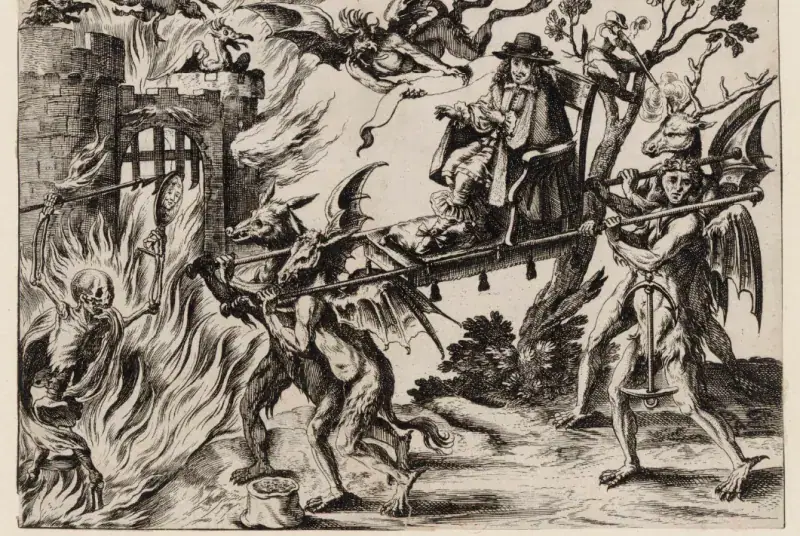
In 1632, a series of bizarre incidents unfolded in Loudun, France, where several young women, including nuns, began experiencing violent convulsions, exhibiting strange behaviors, and claiming to be possessed by demons. Their confessor convinced them that exorcisms were the only remedy, and the women soon accused Urbain Grandier, the local priest, of making a pact with the devil. Grandier, known for his charming demeanor and literary pursuits, had previously clashed with the authorities and had many enemies.
The accusations against Grandier quickly snowballed, with multiple women claiming to have experienced visions of him and accusing him of obscenities and lascivious behavior. As the hysteria spread, Grandier was arrested, interrogated, and eventually put on trial. During the trial, documents purporting to be pacts with the devil, signed by Grandier, were produced as evidence. The trial concluded with Grandier being sentenced to death by burning at the stake on August 18, 1634.
In 1825, Dr. Alexandre Bertrand, a scientist and advocate for the theory of animal magnetism, published an article in the journal "Le Globe" attempting to provide a psychiatric explanation for the events in Loudun. Bertrand argued that the nuns' behavior was not fabricated, but rather a genuine manifestation of a contagious psychological condition. He described the state of "extase" as a natural human state that can occur under certain circumstances, characterized by heightened emotional arousal.
Bertrand's theory suggested that the state of "extase" was responsible for the mass hysteria that spread among the women in Loudun, leading them to exhibit similar symptoms and accusations against Grandier. This explanation offered an alternative to the prevailing view that the nuns had simply been coached to feign possession. Bertrand's insights provided a new perspective on the case, shifting the focus from supernatural explanations to a more nuanced understanding of psychological influences.
The case of the "demons of Loudun" has continued to captivate historians and artists over the centuries. In 1952, author Aldous Huxley wrote a narrative about the events, and in 1971, filmmaker Ken Russell adapted the story into a film. These works demonstrate the enduring fascination with the case, which remains a topic of interest for those exploring the complexities of human psychology and the power of mass hysteria.
Urbain Grandier's legacy is a complex one, with some viewing him as a martyr and others as a victim of circumstance. His literary works, including a scathing pamphlet against Cardinal Richelieu, had earned him many enemies, which likely contributed to his eventual downfall. Despite the passage of time, the case of the "demons of Loudun" remains a thought-provoking example of the dangers of mass hysteria and the importance of considering psychological explanations for seemingly inexplicable events.
The story of the "demons of Loudun" serves as a reminder of the often-blurred lines between faith, psychology, and superstition. As historians continue to study the case, they are reminded of the importance of approaching such events with a nuanced understanding of the complex factors at play. By examining the events in Loudun through a multidisciplinary lens, researchers can gain a deeper understanding of the psychological, social, and cultural influences that shape human behavior.
Key points
- Dr. Alexandre Bertrand offered a psychiatric explanation for the mass hysteria in Loudun, suggesting that the state of "extase" was a natural human state that could be triggered by heightened emotional arousal.
- The case of the "demons of Loudun" has been the subject of numerous artistic interpretations, including works by Aldous Huxley and Ken Russell.
- Urbain Grandier's fate was sealed when he was accused of making a pact with the devil and was subsequently tried, found guilty, and executed by burning at the stake.