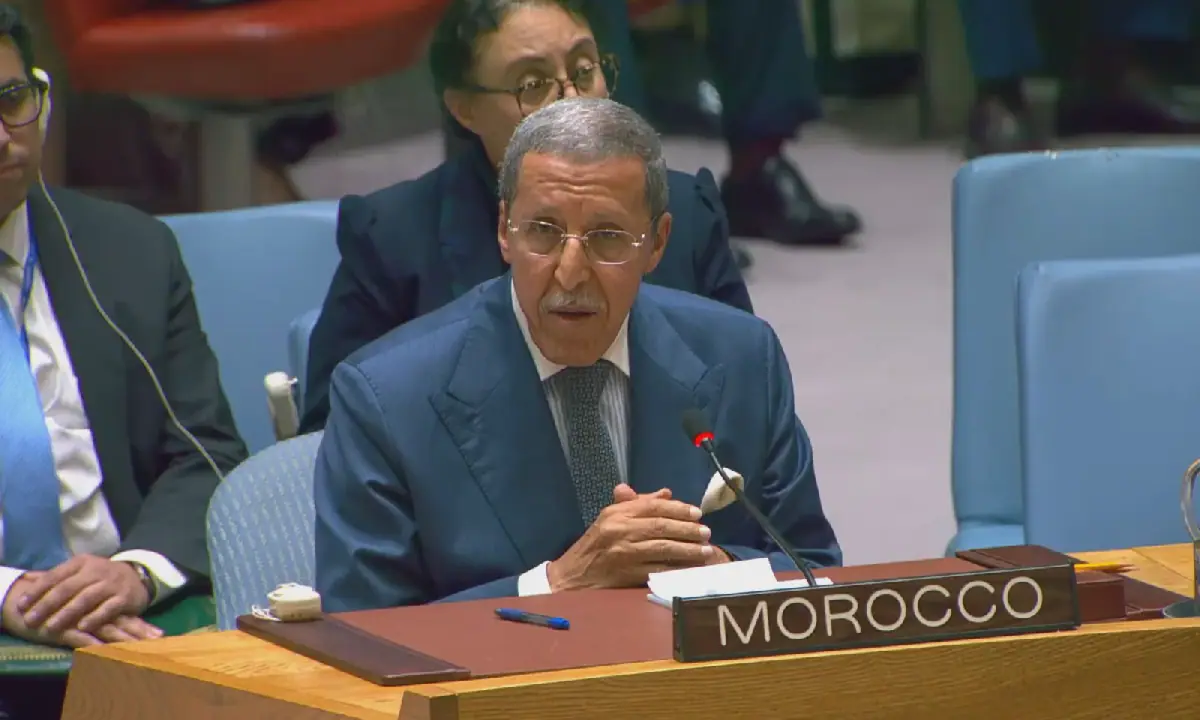
A heated exchange took place at the UN Security Council between Morocco's ambassador to the United Nations, Omar Hilale, and Algeria's ambassador, Amar Bendjama. The tension arose after Russia vetoed a US-drafted resolution on Western Sahara, which would have scaled back the military component of the UN peacekeeping mission and fixed Morocco's Autonomy Plan as the basis for negotiating an end to the conflict.
The US-drafted resolution, which was vetoed by Russia, would have renamed the mission from MINURSO to MINUSO and extended its mandate to October 31, 2027. It also requested the Secretary-General to submit proposals for a restructured mission, including a reduction of authorized uniformed personnel and the closure or consolidation of team sites. The text described Morocco's autonomy proposal under Moroccan sovereignty as the only basis for negotiation and called genuine autonomy "the most feasible solution."
Algeria's ambassador, Amar Bendjama, questioned the role of the penholder and the basis for negotiations, citing self-determination and sovereignty. He argued that the draft treated negotiations "as having been concluded without them having even begun" and imposed the "sovereignty of the occupying power" as its starting point. Bendjama also tied the file to Gaza, calling the arrangement "an indecent transaction, a shameful transaction concluded to the detriment of the Palestinian people."
Morocco's Omar Hilale responded by challenging Algeria's right to address the file, stating that the international community is "fed up" with Algeria's lectures on international law. Hilale asked, "Under what right are you doing this?" and accused Bendjama of choosing "to play the victim, to speak on behalf of others." He also highlighted the issue of refugee registration in Tindouf, arguing that Algeria refuses to allow an official registry.
Hilale tied the refusal to register refugees to the presence of "Malian and Algerian refugees in those camps" and stated that Morocco would accept a figure of one million if a count were allowed. He emphasized that protection doesn't fall from the sky and that the first rule is to register and identify the people involved. Hilale also accused the Polisario Front of drawing children "into military exercises" and charged that residents cannot leave the camps or move freely.
The exchange between Hilale and Bendjama also touched on the issue of humanitarian assistance in the camps. Hilale argued that humanitarian assistance is requested, but instead of that, weapons are handed over and the Polisario is being militarily equipped. He drew a contrast between aid and arms in the camps, stating that there are enough weapons but "not enough food."
Hilale concluded by criticizing Bendjama's comparison between Western Sahara and Palestine, calling it a "shameful comparison." The exchange highlights the ongoing tensions between Morocco and Algeria over the Western Sahara conflict and the role of the UN peacekeeping mission in the region.
Key points
- Morocco's Omar Hilale challenges Algeria's right to lecture the Security Council on international law.
- The US-drafted resolution on Western Sahara was vetoed by Russia.
- The conflict over Western Sahara has been ongoing for over 50 years.