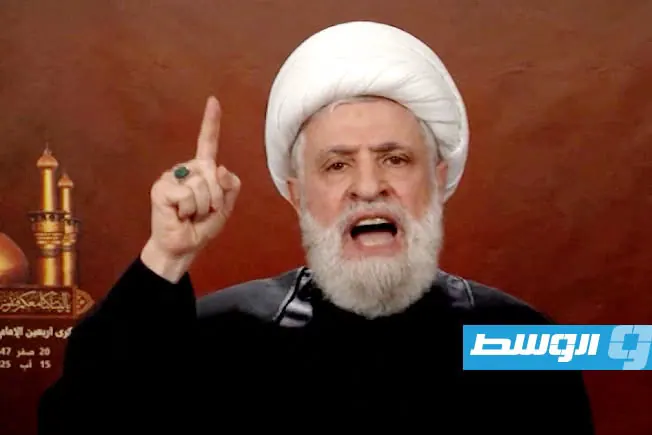
Hezbollah's Secretary-General, Naim Qassem, stated on Sunday that Israel has failed to break the resistance. He made these comments during a televised speech on the anniversary of the assassination of former Hezbollah Secretary-General Hassan Nasrallah, who was killed in an Israeli strike on Beirut's southern suburbs on September 27, 2024. Qassem emphasized that the resistance has proven its strength.
According to Qassem, Israel's military, with 90,000 soldiers and officers, was unable to achieve its goals of breaking the resistance and ending its existence. He highlighted that the resistance has prevented Israel from establishing settlements in Lebanon and thwarted its occupation plans. Qassem's speech was broadcast during a gathering of thousands of Hezbollah supporters.
Qassem stressed that the resistance has stopped Israel's aggression project and is facing Israel, which is supported by the United States, with all available capabilities. He mentioned that Hezbollah has been able to resist in various locations, including Bint Jbeil, Khiam, Aita al-Shaab, and others. Qassem noted that while maintaining a presence in a location is important, it is not the primary objective.
Hezbollah's Secretary-General provided specific examples of resistance, citing the group's three-month presence in Ali al-Tahir. He explained that the resistance operates based on two main principles: facing the enemy in a specific location and time, and preventing the enemy from stabilizing and establishing occupation. Qassem emphasized that this is achieved through a comprehensive effort.
The Israeli military has recently intensified its airstrikes in the Nabatieh area, and continued to carry out operations, including demolitions and explosive ordnance disposal. Although the intensity of hostilities in Lebanon decreased in late June following an Iranian-American understanding and a framework agreement between Lebanon and Israel, Israel has continued its strikes.
The Lebanese Prime Minister has emphasized the importance of the army's deployment in the south, which is seen as a restoration of state authority. Meanwhile, Hezbollah has vowed to respond to Israeli aggression with suitable measures. The situation remains tense, with ongoing clashes and diplomatic efforts to reduce tensions.
The anniversary of Nasrallah's assassination has sparked renewed attention to the Israeli-Hezbollah conflict. Hezbollah's resistance has been a significant factor in the region, and its continued presence has implications for Israel and the broader Middle East. The situation is being closely watched by regional and international actors.
Key points
- Israel's attempts to break Hezbollah's resistance have failed.