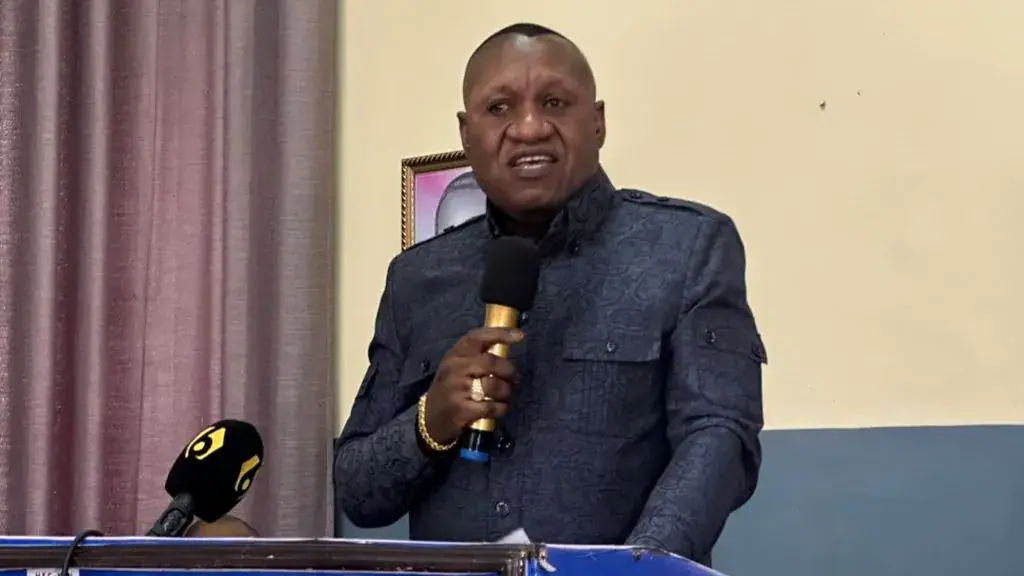
On a recent Friday, the Haute Ecole de Commerce in Kinshasa was abuzz with excitement as Jules Alingete, former Inspector General of Finance, addressed students on the effectiveness of financial patrols. Alingete, a renowned expert in financial control, presented a clear and concise explanation of the a priori control mechanism in public finances. His pedagogical approach won over the audience, comprising students from the former ISC. The lecture was part of an academic conference at the HEC, where Alingete shared his expertise on the importance of proactive financial control.
During the lecture, Alingete described the a priori control mechanism as a vital tool in preventing financial delinquency. He explained that this approach allows for the anticipation and surveillance of public fund management, thereby preventing acts of embezzlement. The former financial inspector emphasized that corruption has severe consequences for a nation, resulting in lost billions, unbuilt schools, unequipped hospitals, and unconstructed roads. Alingete stressed that good governance of public finances is essential for social well-being, quality of life, and social peace.
Alingete highlighted the benefits of effective public financial management, including equitable distribution of national resources and integral societal development. Conversely, he warned that poor financial management leads to collective misery and underdevelopment. As a responsible citizen, it is crucial to ensure that public funds are allocated to their intended purposes, such as infrastructure development, education, and healthcare. The lecture aimed to educate students on the importance of financial responsibility and the role they can play in promoting transparency.
The a priori control mechanism has yielded significant results, according to Alingete. The approach has improved the quality and traceability of public expenditure, preventing irregular spending. Additionally, it has maximized public revenue and enhanced the treasury of public establishments. Alingete cited the reduction of illegal exemptions and improved adherence to public market procedures as notable achievements. The control mechanism has contributed to the country's enhanced credibility on the international stage, with the Democratic Republic of Congo making progress in Transparency International's rankings.
Alingete shared impressive statistics on revenue mobilization, revealing that the country's budget has grown from $5 billion in 2020 to $14 billion currently, with projections reaching $17 billion. If reforms are successfully implemented, the country aims to reach $24 billion by 2027. The former Inspector General of Finance attributed this progress to the effective implementation of the a priori control mechanism.
Alingete's book, "Patrouille financière," serves as a testament to his experience and expertise in financial control. The book aims to transmit knowledge and expertise to future generations, providing a practical guide on preventing financial fraud and embezzlement. Alingete expressed his desire to share his know-how and promote a culture of transparency and accountability.
Following Alingete's lecture, Professor Toussaint Tshilombo advocated for the inclusion of a priori control in university curricula. He envisioned a scenario where the subject would become a compulsory course, emphasizing its importance in promoting financial responsibility and good governance. The audience responded positively to the proposal, recognizing the value of integrating financial control into academic programs.
Key points
- Effective implementation of a priori control has led to improved financial management and transparency in the Democratic Republic of Congo.
- The control mechanism has contributed to the country's enhanced credibility on the international stage.
- Alingete's expertise and experience in financial control are being transmitted to future generations through his book, "Patrouille financière".